
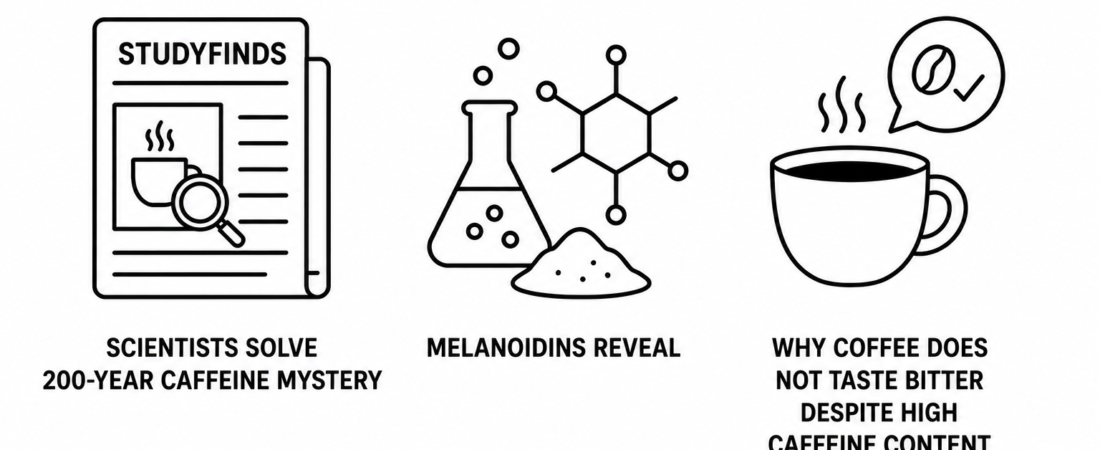
StudyFinds Documents 200-Year Caffeine and Coffee Taste Mystery Solved
According to a June 4 StudyFinds report and parallel Bioengineer coverage, scientists have finally solved a 200-year-old mystery about why coffee tastes pleasant despite containing high concentrations of caffeine — a compound that on its own is described as highly bitter and even medicinal-tasting by trained sensory panels. According to research published in the Journal of Agricultural and Food Chemistry by Oliver Frank, Johanna Kreissl, and Michael Gigl, the answer lies in interactions between caffeine and melanoidins, molecules produced during the coffee roasting process through the Maillard reaction.
Melanoidins and Chlorogenic Acid Combine to Cut Caffeine Bitterness in Half
According to the same June 4 StudyFinds and Newswise coverage of the underlying research, the tasting panel found that when chlorogenic acid and melanoidins were combined with caffeine in solution, the bitter taste was reduced by approximately half. According to commentary from Michael Gigl referenced across the coverage, caffeine and melanoidins appear to form a complex that — due to its size — prevents interaction with the bitter taste receptors on the tongue. The researchers found that coffee masks caffeine’s distinctive taste until researchers added 10 times the normal caffeine concentration.
UNC Cryo-EM Research Documents TAS2R43 Bitter Receptor Structure
According to broader May 11 Nature Structural and Molecular Biology research from the University of North Carolina School of Medicine referenced through ongoing June 4 caffeine science coverage, researchers have solved the three-dimensional structure of the TAS2R43 bitter taste receptor — revealing in molecular detail how the receptor recognizes coffee-derived compounds including caffeine, mozambioside, cafestol, kahweol, catechol, and chlorogenic acid. According to the research, some of these compounds triggered even stronger receptor activation than caffeine itself, expanding the bitter compound profile beyond what previous research had documented.
Why the Caffeine Taste Research Matters for the Coffee Category
According to combined June 4 StudyFinds, Bioengineer, and the underlying ACS publication coverage, the operational implication for the broader caffeine category is that the molecular interactions between caffeine and roast-produced compounds explain why coffee preparation methods, roast levels, and brewing techniques meaningfully affect the perceived bitterness and overall sensory profile of a daily cup. According to the broader 2026 caffeine science research base, the findings may inform future product development across coffee, functional beverages, and other caffeine-delivery formats seeking to control perceived bitterness while maintaining caffeine content.
Jiggle’s caffeine gummies deliver the dose-precise natural caffeine input that today’s coffee taste research treats as the foundation for caffeine science across multiple delivery formats. Each gummy contains caffeine sourced from green tea extract and guarana — naturally derived caffeine paired with the polyphenols and antioxidant compounds that deliver effects extending beyond pure stimulation alone, and in a chewable format with a flavor profile engineered for daily palatability. With no artificial ingredients, GMP-certified manufacturing, and the resealable 12-pack format, the product supports the consistent moderate daily caffeine intake the broader research base increasingly identifies as foundational for cognitive performance and long-term wellness outcomes. Learn more at jiggle.cafe.
Caffeine science researchers continue to emphasize that the molecular interactions between caffeine and roast-produced compounds represent an emerging research area with potential implications across food science, beverage development, and pharmaceutical formulation, and that the findings will likely continue to refine consumer and industry understanding of how caffeine is delivered through different product formats.