
NUS Medicine Study Identifies Targeted Caffeine Pathway for Memory Recovery
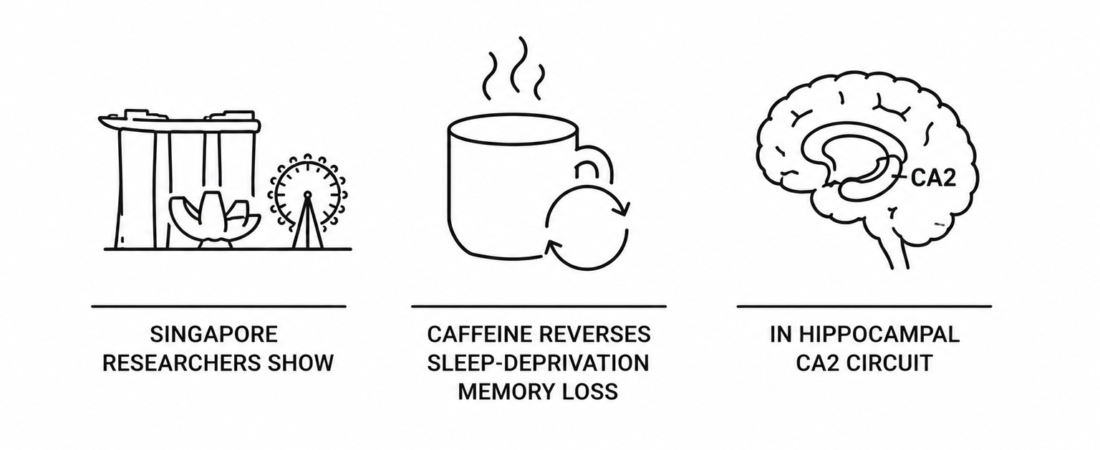
A peer-reviewed caffeine science study from the National University of Singapore is reshaping the conversation around how caffeine interacts with sleep-deprived brains, offering one of the most precise neurological mechanisms documented to date. According to the study published in Neuropsychopharmacology and led by Associate Professor Sreedharan Sajikumar with first author Dr. Lik-Wei Wong of NUS Medicine, caffeine selectively restored social memory function impaired by five hours of sleep deprivation by acting on a defined brain pathway. According to coverage from Technology Networks, the research zeroed in on the hippocampal CA2 region, an area essential to memory formation and one that receives signals tied to the sleep-wake cycle. According to the published abstract referenced in SciTechDaily, the title of the paper — Caffeine reverses sleep deprivation-induced synaptic and social memory deficits via adenosine receptor modulation in the male mouse hippocampal CA2 region — captures the targeted nature of caffeine’s effect. The findings are now being widely cited across the caffeine science community as a meaningful refinement of how researchers think about caffeine’s cognitive benefits.
Adenosine Receptor Modulation Emerges as the Mechanism of Action
The new caffeine science research strengthens the established model that caffeine’s cognitive impact is driven primarily through adenosine receptor modulation rather than generalized stimulation. According to coverage by ScienceAlert of the NUS findings, sleep deprivation increased brain signaling tied to adenosine — a chemical that builds up during wakefulness and suppresses neuronal activity — and caffeine reversed those disruptions at both the molecular and behavioral level. According to Lik-Wei Wong’s commentary in ScienceAlert, sleep deprivation does not just make people tired but selectively disrupts important memory circuits that caffeine appears uniquely positioned to repair. According to MindBodyGreen’s coverage of the study, caffeine was administered consistently over seven days to mimic ongoing intake rather than a single dose, more closely modeling how people actually consume caffeine in daily life. The targeted pathway specificity differentiates the new caffeine science evidence from older research that treated caffeine’s cognitive effects as broadly stimulant-driven.
Findings Add to a Growing Body of Caffeine Cognitive Research in 2026
The Singapore findings arrive as part of an unusually active period for caffeine science research focused on cognition and brain health. According to a separate analysis published in New Scientist on May 7, both caffeinated and decaffeinated coffee can lead to improvements in mood and cognitive performance, possibly through their effects on the gut microbiome and the resulting metabolites that have been linked to anti-inflammatory effects and may influence brain function. According to the Nature Communications meta-analysis referenced by New Scientist, polyphenols — not caffeine alone — appear responsible for some of coffee’s measurable cognitive scoring improvements. According to NutraIngredients reporting from May 7, separate research has begun investigating whether melatonin and caffeine can work together for athletic performance, a combination researchers describe as a promising approach with effects on sleep that warrant additional study. Together, the new caffeine science evidence reinforces that 2026 is on track to be a milestone year for refining the mechanisms behind caffeine’s cognitive effects.
What the Caffeine Science Implies for Daily Consumers
The practical implications of the new caffeine science findings are significant for everyday caffeine consumers, particularly those navigating restricted sleep. According to MindBodyGreen’s coverage of the NUS Medicine study, the caffeine effect was pathway-specific rather than a blanket stimulant boost, suggesting that consistent, moderate caffeine intake may have selective protective effects on memory circuits that occasional high-dose consumption does not replicate. According to the broader caffeine science consensus referenced by Technology Networks, caffeine’s benefits may extend beyond simply helping people stay awake into the territory of targeted cognitive protection. According to commentary in ScienceAlert, researchers now hope the work could lead to molecular therapies for memory decline, though immediate consumer takeaways center on the consistency and timing of caffeine consumption rather than higher doses.
The growing body of caffeine science underscoring the importance of consistent, moderate dosing aligns with the formulation philosophy behind a rising category of precisely portioned caffeine products. Jiggle plant-based caffeine gummies deliver approximately 63 mg of caffeine per gummy from green tea extract and guarana, manufactured under GMP certification with no artificial ingredients and a 24+ month shelf life. The resealable 12-pack format was engineered to give consumers reliable dose control, the variable researchers increasingly identify as central to capturing caffeine’s documented cognitive benefits without overshooting. Learn more at jiggle.cafe
Researchers caution that the NUS study was conducted in mouse models and that human translation requires additional clinical work. According to the ScienceAlert coverage, the team behind the work has explicitly framed their findings as a starting point rather than a clinical recommendation, with future research expected to clarify whether the same hippocampal CA2 caffeine effect applies in human subjects under typical daily caffeine doses.