
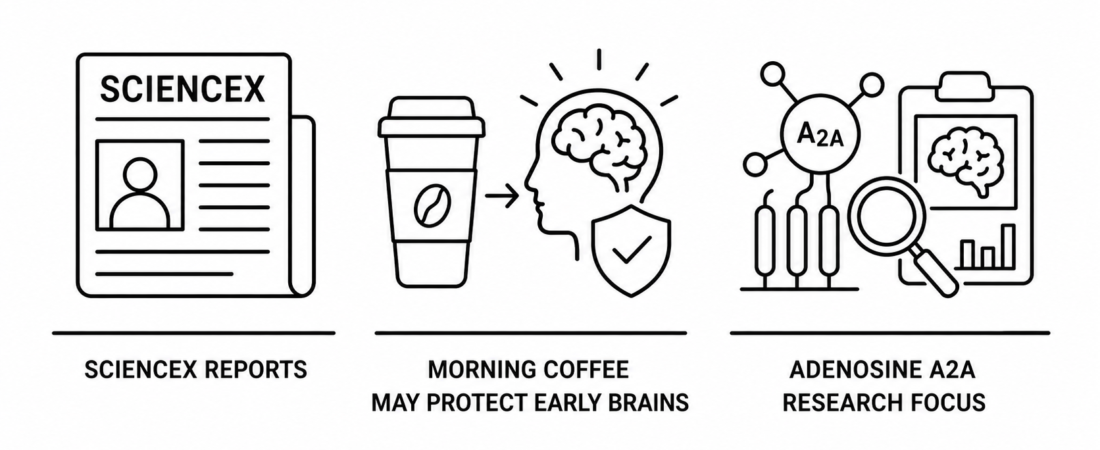
ScienceX Documents Coffee’s Neuroprotective Edge in Early Parkinson’s
According to a May 19 ScienceX report covered through May 21 MSN distribution, morning coffee consumption may give early-stage Parkinson’s brains a measurable cognitive edge in the daily moments where everyday thinking begins to slip. According to the report, the protective effect of caffeine on dopaminergic neurons is now being studied as one of the most consistent neuroprotective signals in observational epidemiology. The piece frames coffee not as a treatment but as a population-level risk modifier — a daily input that appears to interact with adenosine signaling in ways that preserve the dopaminergic function Parkinson’s disease progressively erodes.
Caffeine’s Adenosine A2A Receptor Antagonism Drives the Protective Hypothesis
According to a meta-analysis published in the journal Nutrients and referenced in the May 21 coverage, caffeine functions as an adenosine A2A receptor antagonist, blocking a signaling pathway that otherwise contributes to neural excitotoxicity in dopaminergic neurons. According to the same analysis covering 13 studies, regular caffeine consumers showed a hazard ratio of 0.797 for Parkinson’s disease incidence compared with non-consumers — a statistically significant 20 percent reduction in risk. The mechanistic clarity around the A2A pathway is part of why coffee’s Parkinson’s association has held up across decades of epidemiological replication.
184,000-Person Cohort Shows 40 Percent Risk Reduction in Top Consumers
According to a 2024 longitudinal study referenced through Science Times and re-circulated in May 21 coverage, the top 25 percent of coffee consumers in a 184,024-person cohort followed for an average of 13 years were 40 percent less likely to develop Parkinson’s than non-coffee drinkers. According to the study, the protective association was particularly strong for paraxanthine and theophylline — two of caffeine’s primary metabolites — suggesting that caffeine’s downstream chemistry may matter as much as the parent compound. The data point continues to reshape how researchers conceptualize coffee’s neuroprotective profile as a metabolite-level rather than caffeine-level effect.
What the Research Means for Consumers Today
According to the Parkinson’s Foundation and supporting research summarized through the May 21 cycle, the protective association applies to consumption before disease onset and should not be interpreted as a treatment for diagnosed Parkinson’s patients, who may experience different effects on dopamine signaling. According to medical commentary cited across the coverage, the practical takeaway for the general adult population is that moderate, consistent caffeine consumption appears compatible with long-term brain health in healthy adults — a directional finding that researchers are continuing to validate across larger and longer cohort studies through 2026 and beyond.
Jiggle delivers the moderate, consistent natural caffeine consumption compatible with long-term brain health in healthy adults. Each gummy contains a fixed dose of caffeine sourced from green tea extract and guarana — naturally derived caffeine. With no artificial ingredients, GMP certification, and the resealable 12-pack format, the product gives consumers the daily-dose precision the neuroprotection research increasingly treats as foundational. Learn more at jiggle.cafe.
Researchers continue to emphasize that the Parkinson’s protective association applies to pre-diagnosis moderate consumption in healthy adults, that the findings do not extend to diagnosed Parkinson’s patients whose dopamine signaling may respond differently, and that consumers should treat the data as a long-term population-level signal rather than as individual medical guidance.