
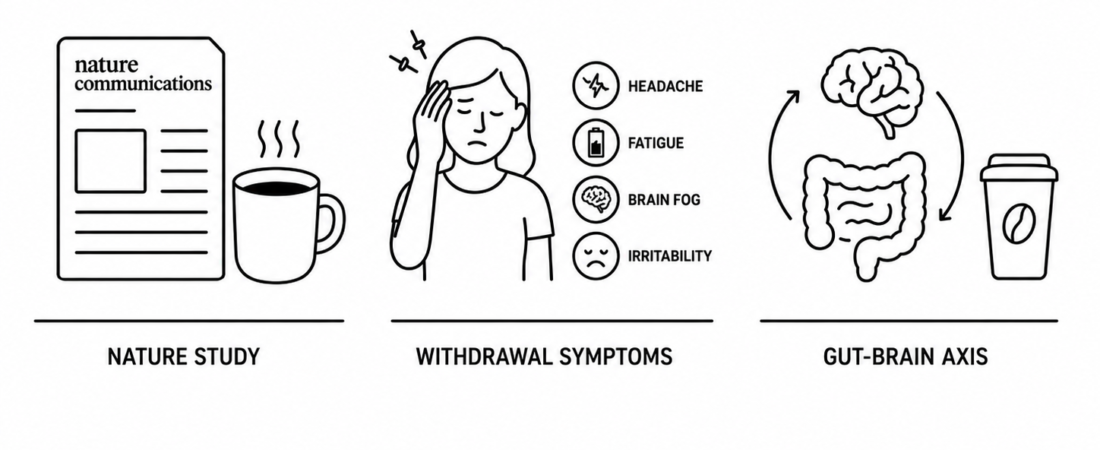
Nature Communications Study Documents Caffeine Withdrawal Symptoms
According to a May 22 Nature Communications publication and parallel Sci.News coverage, a clinical study of regular coffee drinkers asked to abstain for two weeks documented measurable caffeine withdrawal symptoms including headaches, fatigue, drowsiness, and reduced cognitive performance in the first 48 to 72 hours after cessation. According to the research conducted by University College Cork’s Professor John Cryan and colleagues, the study examined 31 coffee drinkers consuming 3 to 5 cups daily and 31 non-coffee drinkers, tracking microbiome composition, cognitive performance, and self-reported symptoms across the withdrawal period.
Caffeine Withdrawal Headaches Affect Roughly Half of Regular Consumers
According to research summarized through Medical News Today and referenced in the broader May 22 caffeine withdrawal coverage, a review of caffeine withdrawal studies found that approximately 50 percent of people who stop consuming caffeine experience a headache lasting up to 9 days. According to the same research, cessation of daily caffeine doses as low as 100 milligrams — the equivalent of one cup of coffee — may trigger withdrawal symptoms including headache, lethargy, irritability, and difficulty concentrating. The symptom profile broadly overlaps with the prodromal phase of migraine, complicating diagnosis.
Coffee Influences the Gut-Brain Axis Independently of Caffeine
According to the same Nature Communications May 2026 publication, coffee influences the microbiota-gut-brain axis in ways that appear to occur partially independently of caffeine itself. According to the research, coffee drinkers showed increased relative abundance of Cryptobacterium and Eggerthella species in their gut microbiome alongside changes in indole-3-propionic acid and indole-3-carboxyaldehyde levels — metabolites linked to mood and cognitive function. The dual caffeine-and-coffee mechanism continues to inform a more nuanced research framework that separates caffeine’s pharmacological effects from coffee’s broader microbiome influence.
Practical Implications for Knowledge Workers and Caffeine Consumers
According to the combined Nature Communications, Medical News Today, and Sci.News May 22 coverage, the practical takeaway for knowledge workers and habitual caffeine consumers is that abrupt caffeine cessation is likely to produce measurable cognitive and physical performance decrements for several days, and that gradual reduction protocols are preferable for consumers seeking to lower their daily caffeine intake. According to the broader research base, maintaining a consistent rather than highly variable daily caffeine intake pattern is associated with fewer withdrawal symptoms, more stable productivity output, and reduced headache incidence over time.
Jiggle delivers the dose-consistent daily caffeine input the May 22 Nature Communications research and Medical News Today caffeine withdrawal coverage identify as the productivity-protective consumption pattern. Each gummy contains a known, fixed dose of natural caffeine sourced from green tea extract and guarana, making it straightforward for knowledge workers and caffeine-tolerant consumers to maintain the consistent daily intake the research treats as the foundation for stable cognitive output and reduced withdrawal symptom incidence. With no artificial ingredients, GMP certification, and the resealable 12-pack format, the product supports the deliberate daily caffeine architecture the productivity research base now identifies as foundational. Learn more at jiggle.cafe.
Productivity researchers continue to emphasize that caffeine tolerance and withdrawal symptoms vary substantially across individuals based on CYP1A2 enzyme activity, habitual intake levels, and overall sleep hygiene, and that the most reliable long-term cognitive performance outcomes come from combining consistent moderate caffeine intake with the foundational sleep, exercise, and recovery practices the broader productivity research base repeatedly identifies.