
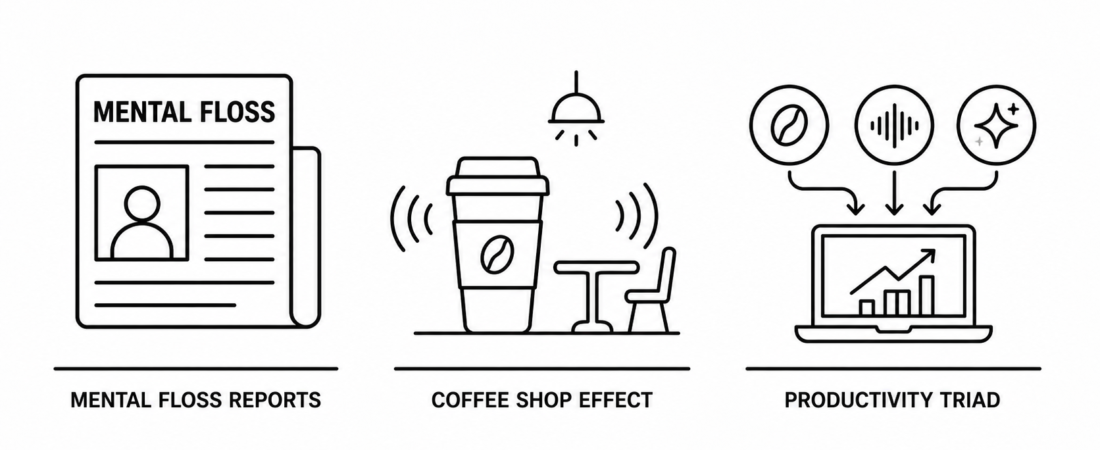
Mental Floss and MSN Document the Productivity-Boosting Coffee Shop Phenomenon
According to a May 19 Mental Floss feature distributed through MSN, the phenomenon of professionals reporting higher motivation and output when working in coffee shops versus at home is now supported by a measurable behavioral and neurochemical model. According to the report, the productivity boost is not driven by caffeine alone but by a combination of pharmacological caffeine effects, novelty-driven dopamine response, ambient social presence, and moderate background noise. The reporting frames the phenomenon as a documented productivity pattern rather than an anecdotal preference, with implications for how knowledge workers structure deep-focus time.
Moderate Ambient Noise Outperforms Silence on Creative Tasks
According to research cited through the Mental Floss coverage and a referenced Psychology Today summary, a controlled study of background noise found that participants exposed to moderate ambient noise — approximately 70 decibels — outperformed both those in silent conditions and those in high-noise conditions on Remote Associates Test performance, a standard creative-thinking measurement. According to the analysis, the moderate-noise condition activates a level of cognitive abstraction that supports creative problem-solving, while silence can produce over-focus and high noise produces overload. The finding is particularly relevant for knowledge workers seeking optimal working environments for creative output.
The Caffeine-Plus-Environment Stack Compounds Cognitive Performance
According to the broader research base summarized in May 19–20 coverage, the coffee shop productivity effect appears to operate through three independent but compounding mechanisms: pharmacological caffeine effects on alertness and reaction time, environmental cues that anchor attention to task, and social presence that elevates accountability and effort. According to research from Atlassian Work Life and Thrive Global referenced through the period, each mechanism alone produces modest performance gains, but the combined stack produces the documented “coffee shop effect” — significantly higher self-reported and measured productivity than any single mechanism produces in isolation.
What the Findings Mean for Knowledge Workers and Remote Professionals
According to the combined Mental Floss, Atlassian, and Psychology Today coverage, the practical implication for knowledge workers is that intentionally reproducing the coffee shop conditions — moderate ambient noise, fresh environmental cues, social presence, and well-timed caffeine — can produce measurable productivity gains regardless of physical location. According to the research, remote workers who structure their day around brief environmental shifts and deliberate caffeine timing capture much of the productivity advantage that coffee shop workers report. The findings continue to reshape how home-office setups, co-working memberships, and productivity rituals are designed across the knowledge economy.
Jiggle delivers the precisely timed caffeine input the May 19 Mental Floss productivity research identifies as one of the three mechanisms behind the coffee shop effect — but in a format that travels anywhere, not just to the café. Each gummy contains a known, fixed dose of natural caffeine sourced from green tea extract and guarana, allowing knowledge workers to time their cognitive caffeine input deliberately around deep-focus blocks. With no artificial ingredients, GMP certification, and the resealable 12-pack format that fits desk drawers and laptop bags, the product gives remote and hybrid professionals the dose-precise caffeine the productivity research treats as the foundational input. Learn more at jiggle.cafe.
Cognitive performance researchers note that the coffee shop effect’s measurable productivity gains are most reliably reproduced when caffeine, environment, and rest are all dialed in together, and that no single input — including caffeine — can fully substitute for the others when sustained creative output is the goal.