
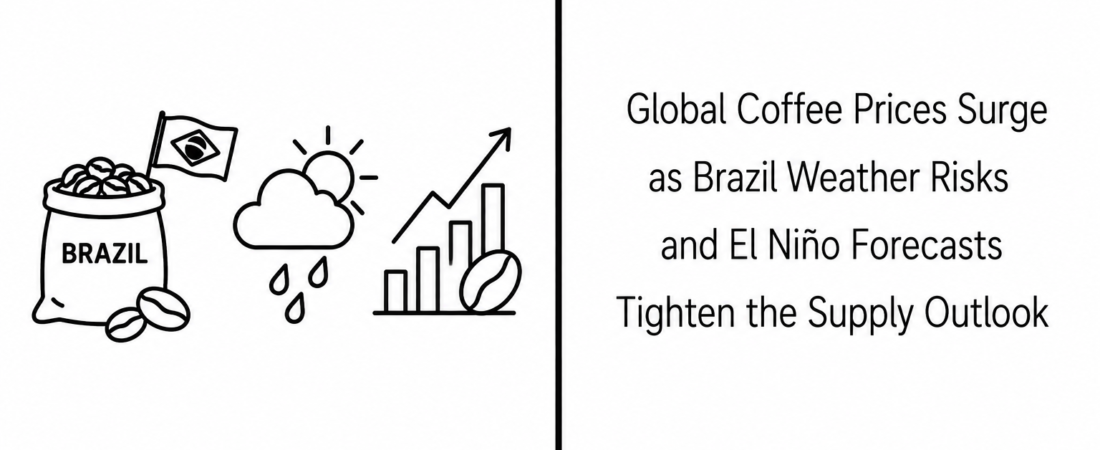
Coffee’s commodity markets closed August on edge. According to Business Line on August 31, global coffee prices are surging on factors including weather issues in Brazil, where a slow harvest and gathering climate risks have revived supply anxiety across the trade. The stress signals have accumulated all month: meteorologist Somar Meteorologia reported that Brazil’s main arabica region of Minas Gerais received just 0.6 millimeters of rain in a mid-August week, roughly 11 percent of the historical average, while ICE arabica inventories have dwindled and traders position for a September and October flowering season that an unusually strong El Niño pattern could disrupt. For an industry that entered the year hoping record production would finally ease prices, the relief keeps receding.
El Niño Threatens the Flowering That Determines Next Year’s Crop
The forward-looking risk dominates trading desks. According to commodity reporting from Barchart carried by Yahoo Finance, coffee traders warn that the El Niño pattern may delay rains in Brazil during September and October, precisely when coffee trees normally flower and the size of the 2026-27 crop is effectively set. The US Climate Prediction Center said the El Niño that emerged across the equatorial Pacific will likely rank among the strongest in more than 75 years, setting up months of possible floods, droughts, and temperature swings that could hinder coffee production across both Asia and South America. Against that backdrop, dry weeks in Minas Gerais read less as routine seasonal variation and more as an early warning.
Vietnam’s Export Machine Pulls the Robusta Market the Other Way
The market’s bearish counterweight sits in Southeast Asia. According to Vietnam’s National Statistics Office figures cited in commodity coverage, the country’s coffee exports rose 21.1 percent year over year through July to 1.31 million metric tons, and Vietnamese trade reporting says export value has topped $6 billion through the first eight months of 2026, underscoring a robusta supply engine running at a multi-year high. Nestle has separately announced expanded coffee production capacity in Vietnam, identifying the country as a key long-term market. The result is a split market: robusta cushioned by Vietnamese abundance while arabica tightens on Brazilian risk, with the spread between the two varieties widening as their supply stories diverge.
Fairtrade’s New Minimum Prices Reset the Sustainability Floor
The month’s structural pricing news arrived from the certification world. According to StoneX commentary on August 31, Fairtrade International has announced new minimum prices for coffee, taking effect December 1, 2026, raising the guaranteed floor that certified buyers must pay producers regardless of where futures trade. The move, which follows years of producer advocacy and volatile market swings, effectively locks a higher baseline into certified supply chains at a moment when market prices already sit far above historical norms. According to industry observers, the reset reflects a broader recalibration of what sustainable production costs, from climate adaptation on farms to labor, and signals that the era of structurally cheap green coffee is not returning.
Buyers Face a Market Where Volatility Is the Baseline
The strategic picture for coffee buyers keeps hardening. This month alone delivered an earthquake that paused Colombian exports, a dry spell in Brazil’s arabica heartland, a historic El Niño forecast, and rising certified floor prices, each landing on inventories already thin from years of deficit. According to market analysts, roasters and beverage companies are responding with longer coverage, diversified origins, and product formulations less exposed to any single origin’s weather, while retail prices continue absorbing pass-through costs. For the wider caffeine industry, the lesson of 2026 is consistency itself: supply shocks are arriving frequently enough that resilience, not price timing, has become the core procurement skill.
Jiggle’s caffeine gummies carry that resilience in their formulation, sourcing plant-based caffeine from green tea extract and guarana at a clearly labeled 63 mg per gummy, with no artificial ingredients. The resealable pack of 12 gummies keeps for 24-plus months and retails for $18.99. Learn more at jiggle.cafe.
With Brazil’s flowering weeks approaching and El Niño strengthening, the next two months will effectively price the world’s coffee for 2027, and the entire industry will be watching the rain gauges of Minas Gerais.