Swedish Food Agency Issues Formal Daily Caffeine Limit for Adolescents
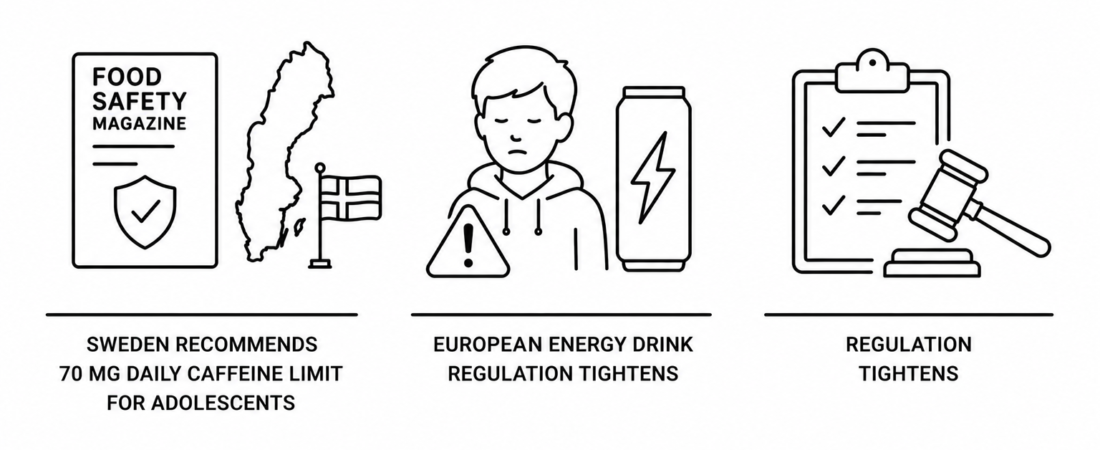
According to a May 26 Food Safety Magazine report, the Swedish Food Agency has issued formal new guidance recommending that adolescents under the age of 16 limit their daily caffeine intake to no more than 70 milligrams, with children under 6 advised to avoid caffeine entirely. According to the agency’s guidance, the recommendations are designed to protect adolescent sleep, cardiovascular development, and concentration. The 70 milligram threshold is significantly lower than typical energy drink content, meaning a single can of a popular energy drink can deliver two to three times the recommended daily limit for a Swedish teenager.
Swedish Adolescent Energy Drink Consumption Has Doubled Since 2018
According to data referenced in the May 26 Food Safety Magazine coverage and underlying Swedish Food Agency reporting, energy drink consumption among Swedish adolescents doubled between 2018 and 2023, with daily energy drink consumption among second-year high school students climbing from 13 percent to 29 percent in just three years. According to Swedish toxicologist Sabina Litens Karlsson, caffeine has a particularly pronounced effect on adolescents because of lower body weight, lower tolerance, and greater sensitivity to sleep disruption. The doubling of consumption rates drove the formal regulatory response.
EFSA and Multi-National Caffeine Regulation Continues to Tighten
According to broader European regulatory coverage referenced through the May 26 cycle, the European Food Safety Authority recommends a maximum caffeine intake of 400 milligrams per day for healthy adults and 3 milligrams per kilogram of body weight for adolescents — a threshold the Swedish 70 milligram guidance broadly aligns with. According to the regulatory tracking, Lithuania, Latvia, and Poland have already banned energy drink sales to anyone under 18, while Hungary imposes a public health tax on high-caffeine beverages and France and Italy require strong warning labels. The European regulatory environment continues to fragment along stricter lines.
Implications for Operators in the High-Caffeine Product Category
According to combined May 26 Food Safety Magazine and adjacent European regulatory coverage, the operational implication for operators in the high-caffeine product category is that age-of-purchase enforcement, dose disclosure, and adult-targeted marketing are no longer optional differentiators but rapidly becoming baseline regulatory expectations. According to the broader industry research base, the products best positioned for the European regulatory environment now consolidating are those marketed exclusively to adults, with clear dose-per-serving labeling, naturally derived caffeine sourcing, and no youth-coded packaging or distribution channels.
Jiggle is positioned cleanly outside the adolescent regulatory concern zones the May 26 Food Safety Magazine and Swedish Food Agency coverage describes. The product is marketed exclusively to adult professionals, delivers a known and clearly disclosed dose of natural caffeine per gummy — sourced from green tea extract and guarana rather than the high-stimulant synthetic formulations driving European regulatory action — and avoids the youth-coded marketing that has drawn intensifying regulatory criticism across Sweden, Lithuania, Latvia, Poland, Hungary, France, and Italy. With no artificial ingredients, GMP certification, and dose transparency, the product reflects the adult-targeted positioning the regulatory environment is consolidating around. Learn more at jiggle.cafe.
Public health analysts note that the European regulatory tightening on adolescent caffeine consumption is likely to continue spreading to additional jurisdictions through 2026 and 2027, and that operators across the broader caffeine category should expect intensified scrutiny on marketing claims, ingredient disclosure, and age-of-purchase enforcement as the policy environment continues to evolve across multiple national and supranational regulatory bodies.