
Functional Foods Become the Default Caffeine Delivery Vehicle
According to a May 21 Food Business News report on the evolution of functional foods, brands across the snack, confectionery, and beverage categories are now layering caffeine and adaptogenic ingredients into existing food formats — milk and dark chocolate bites, energy bars, and ready-to-eat snacks — rather than relying solely on traditional energy drink cans. According to the report, the trend reflects an industry-wide recognition that consumers increasingly want caffeine delivered in formats that fit into existing daily eating patterns rather than requiring a separate ritual or category purchase. The structural shift is reshaping where caffeine appears at retail.
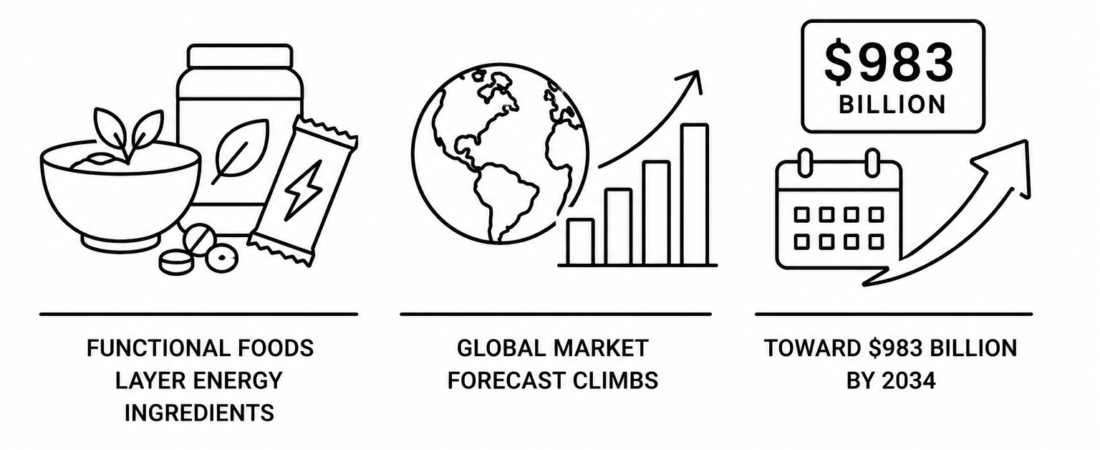
Global Functional Foods Market Projected to Reach $983 Billion by 2034
According to a Fortune Business Insights forecast distributed through EINPresswire and referenced in the May 21 coverage, the global functional foods and beverages market was valued at $398.81 billion in 2025 and is projected to grow to $437.62 billion in 2026 and $983.17 billion by 2034 — a compound annual growth rate of 10.65 percent. According to the analysis, Asia-Pacific dominated the category with a 39.67 percent market share in 2025, while the U.S. functional foods market is forecast to reach $117.22 billion by 2032. The U.S. growth driver: increased adoption of foods rich in nutritional and functional substances among health-conscious consumers.
Coffee Prices Hit November 2024 Lows as Brazil Heads for Record Harvest
According to a May 21 XTB.com market analysis, arabica coffee prices have fallen to their lowest level since November 2024, pressured by improved global supply outlook ahead of a forecast record 2026/27 Brazil harvest. According to projections cited through Barchart, the Coffee Trading Academy forecasts a 12 percent year-over-year harvest increase to 71.4 million bags, while Marex Group and StoneX project record harvests of 75.9 and 75.3 million bags respectively. According to StoneX, the 2026 global coffee surplus is projected to expand to 10 million bags from 1.8 million bags in 2025 — the biggest surplus in six years.
Tanzania and Uganda Position for Specialty Coffee Growth
According to a May 20 Ecofin Agency report, Tanzania’s coffee industry is targeting another record harvest in the 2026-27 season, building on multi-year specialty coffee investment. According to a related May 19 PML Daily report on Uganda’s emerging Excelsa coffee variety, researchers believe Excelsa could help Uganda diversify its coffee industry while preparing for climate-related challenges affecting Arabica production globally. The dual development signals that African specialty coffee origins are positioning to capture share as climate-driven volatility continues to reshape the geographic distribution of premium coffee production through the back half of the decade.
Jiggle operates inside the functional foods category Food Business News and Fortune Business Insights identify as the fastest-growing structural format for delivering caffeine to mainstream consumers. Each gummy combines caffeine sourced from green tea extract and guarana with a chewable, food-format delivery — fitting the integration-into-daily-eating-patterns thesis the May 21 coverage describes as the primary consumer driver. With no artificial ingredients, GMP-certified manufacturing, and a resealable 12-pack at $18.99, the product sits in the precision-dosed end of a $437 billion category projected to more than double by 2034. Learn more at jiggle.cafe.
Industry analysts caution that the projected 10.65 percent compound annual growth rate for functional foods through 2034 assumes continued consumer disposable income growth and a stable regulatory environment for novel ingredients, both of which face uncertainty as government policy and macroeconomic conditions evolve across major markets through the remainder of the decade.