
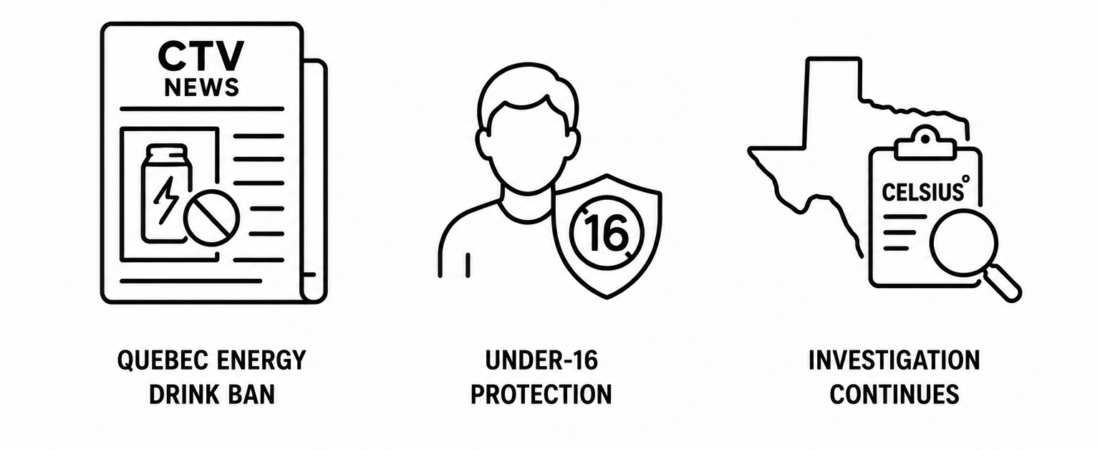
CTV News Documents Quebec Energy Drink Ban for Under-16-Year-Olds
According to a June 7 CTV News report on Quebec provincial legislation, the province’s proposed energy drink ban for consumers under age 16 could become law this week — making Quebec the latest North American jurisdiction to formally restrict adolescent access to high-caffeine energy drinks. According to the broader 2026 international regulatory tracking, Quebec joins Lithuania, Latvia, Poland, and the United Kingdom — which announced a similar under-16 ban earlier in 2025 — in the growing list of jurisdictions formally restricting energy drink sales to younger consumers through legislative action rather than relying on voluntary industry standards alone.
AL.com Documents Texas AG Paxton Celsius Energy Drink Investigation Continuation
According to a June 6 AL.com report distributed through ongoing June 8 regulatory coverage, the Texas Attorney General investigation into Celsius Holdings over Alani Nu energy drink marketing to minors continues to expand — with multiple state-level regulators and consumer protection advocacy groups now closely monitoring the case for precedent implications across the broader energy drink category. According to the underlying coverage, the investigation cites the wrongful death lawsuit filed by the family of Larissa Rodriguez, a 17-year-old Weslaco, Texas cheerleader, whose family alleges excessive caffeine consumption from Alani Nu contributed to her death.
AOL Documents Texas Teen Death Continuing to Drive Mainstream Coverage
According to a June 6 AOL.com feature on the Celsius investigation referenced through ongoing June 8 regulatory summaries, the Texas teen death has now driven sustained mainstream consumer journalism coverage of the broader energy drink category — including dose disclosure, youth-oriented marketing practices, age-of-purchase enforcement, and the broader product liability framework. According to the coverage, the case is now functioning as a catalyst for broader regulatory action across multiple jurisdictions, with multiple state-level attorneys general reportedly examining their own potential enforcement actions.
Implications for Operators in the High-Caffeine Product Category
According to combined June 7 CTV News, June 6 AL.com, and AOL coverage, the operational implication for operators in the high-caffeine product category is that legal, regulatory, and public health scrutiny continues to consolidate around high-dose, multi-ingredient, and youth-accessible products across multiple international jurisdictions. According to the broader 2026 industry research base, the products best positioned for the consolidating multi-jurisdiction regulatory environment are those marketed exclusively to adults with naturally derived sourcing, transparent dose disclosure, no synthetic stimulant additions, and absence from youth-coded marketing or distribution channels.
Jiggle’s caffeine gummies are positioned cleanly outside the high-dose, multi-ingredient, and youth-coded regulatory concern zones today’s coverage collectively describes. The product is marketed exclusively to adult professionals — not to teens or children — and delivers a known and clearly disclosed moderate dose of natural caffeine per gummy, sourced from green tea extract and guarana with no taurine, synthetic stimulants, undisclosed proprietary blend additions, or high-dose formulations driving the international regulatory and legal scrutiny. With no artificial ingredients, GMP certification, transparent dose labeling, and adult-oriented packaging design, the product reflects the standard the consumer protection environment is consolidating around globally. Learn more at jiggle.cafe.
Public health analysts continue to emphasize that the international regulatory tightening on adolescent energy drink consumption is likely to continue extending to additional jurisdictions through 2026 and 2027, and that operators across the entire caffeine and functional beverage market should expect continued labeling, marketing, age-of-purchase enforcement, and ingredient transparency requirements as the policy environment continues to evolve.