
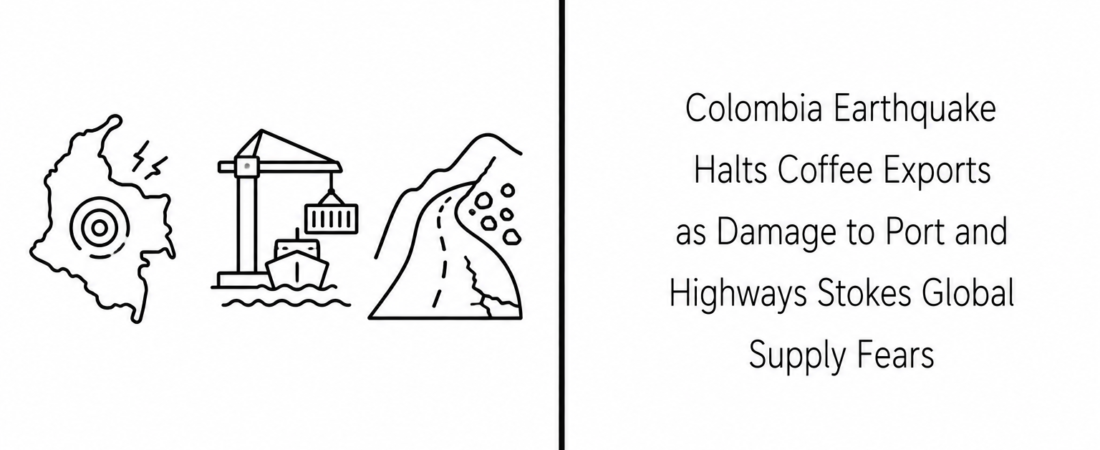
A natural disaster in one of the world’s most important coffee origins is this week’s dominant industry story. According to Bloomberg, Colombian coffee exports are largely paused after the magnitude 7.4 earthquake that struck western Colombia on August 10 disrupted operations at the Port of Buenaventura, the nation’s main coffee gateway, and triggered landslides and roadblocks along key highways, including the Cali-Buenaventura corridor. Gustavo Gomez, president of the exporters association Asoexport, said coffee operations are currently suspended and that there is no official timeline for fully reopening the routes. According to Chosunbiz on August 13, the disruption is stoking global supply fears in a market already sensitized by years of tight arabica supplies and elevated prices.
The Quake Struck the Heart of Colombia’s Coffee Geography
The earthquake’s location magnified its industry impact. According to Global Coffee Report, the epicenter sat near San Jose del Palmar in Choco province, and the Colombian Geological Service called it the most powerful earthquake to strike the country this century, with a death toll in the hundreds and thousands of homes damaged. According to Comunicaffe, the National Federation of Coffee Growers said a large proportion of operations were temporarily suspended in affected areas due to damage to logistics facilities and processing plants, and Director-General German Bahamon announced a rural damage assessment across the producing departments of Risaralda, Valle del Cauca, Caldas, Antioquia, Choco, and Quindio while business continuity protocols were activated with warehousing arm Almacafe.
Buenaventura’s Closure Chokes the Primary Export Artery
The logistics picture explains why exports stopped even where farms survived. According to Coffee Geography Magazine, shipping giant Maersk reported that terminal operations at the Port of Buenaventura were temporarily suspended, and the port handles the vast majority of Colombia’s Pacific agricultural exports. According to analysis cited from commodity pricing firm Expana, the affected route carries approximately 60 percent of Colombia’s coffee exports. The timing compounds the problem: Bloomberg reporting notes the current harvest is concentrated in southern departments, including Cauca, Narino, and Valle del Cauca, regions that ship predominantly through Buenaventura, and Colombia produced 13.4 million 60-kilogram bags in 2025 as the world’s third-largest coffee exporter behind Brazil and Vietnam.
Futures Markets Weigh Disruption Against Intact Plantations
Price reaction has been notable but measured. According to Comunicaffe, New York arabica futures rose about 1 percent for the September contract in the session following the quake, while other reports described sharp intraday swings as traders assessed the damage. The restraint reflects an important distinction drawn by analysts: the earthquake primarily damaged logistics infrastructure rather than the coffee plantations themselves, which means the shock is one of delay rather than lost production. Asoexport has warned, however, that even after routes reopen, accumulated coffee moving at once could create congestion and bottlenecks at ports, extending delivery delays and supply chain pressure well beyond the immediate emergency period.
Buyers Confront Another Reminder of Origin Concentration Risk
The strategic lesson for the industry extends past this event. According to Daily Coffee News, exporters including specialty firm Caravela Coffee reported precautionary mill shutdowns and damage assessments, while roasters worldwide began evaluating exposure to delayed Colombian shipments. Industry analysts note that global arabica prices remain highly sensitive to disruptions in top-tier origins precisely because supply is concentrated: weather, disease, and now seismic events in a handful of countries move the entire market. For beverage and ingredient companies already managing elevated green coffee costs, the episode strengthens the case for diversified sourcing, larger safety stocks, and formulations whose caffeine inputs are not dependent on a single origin’s infrastructure.
Jiggle’s caffeine gummies illustrate that formulation flexibility, sourcing plant-based caffeine from green tea extract and guarana at a clearly labeled 63 mg per gummy, with no artificial ingredients. GMP certified and made in the USA, the resealable pack of 12 gummies keeps for 24-plus months and retails for $18.99. Learn more at jiggle.cafe.
With rescue operations still underway and export timelines uncertain, the human toll remains Colombia’s first concern, while the coffee world watches Buenaventura for the reopening that will determine how long this supply shock lasts.