
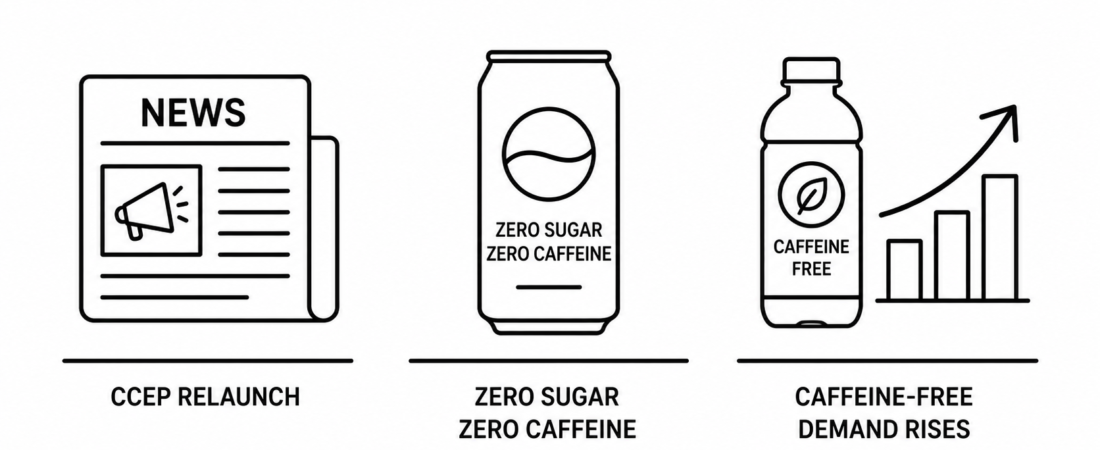
Coca-Cola Zero Sugar Zero Caffeine Relaunch Targets Adult Wellness Consumer
According to a May 26 Coca-Cola Europacific Partners announcement, the company has relaunched Coca-Cola Zero Sugar Zero Caffeine across key European markets — a clear signal that the caffeine-free segment of the soft drink category is now sufficiently scaled to support multi-million-dollar product relaunch investment from the world’s largest non-alcoholic beverage company. According to the company, the relaunch reflects rising consumer demand for evening-friendly soft drinks that deliver the flavor profile of caffeinated cola without the sleep-disruption risk. The relaunch is consistent with the broader 2026 caffeine-free functional beverage expansion.
Tati Westbrook Launches Go Go Juice in Functional Beauty-Beverage Crossover
According to a May 26 BeautyNewsDaily report, beauty creator Tati Westbrook has launched Go Go Juice — a functional beverage brand positioned at the intersection of caffeine, wellness, and beauty industry consumer routines. According to the coverage, the launch reflects an accelerating 2026 pattern in which beauty creators and personal-care brands are entering the functional beverage category to capture share of a daily consumption ritual that has historically belonged to coffee, tea, and traditional energy drinks. The category convergence is reshaping which brands compete for the consumer’s morning and afternoon caffeine occasions.
Coffee Substitute Market Forecast Highlights Caffeine-Free Demand Trend
According to a May 25 GlobeNewswire report distributed through Yahoo Finance, the global coffee substitute market is projected to expand significantly through 2035, with rising demand for caffeine-free alternatives identified as one of the primary growth drivers. According to the report, the demand pattern is being supported by consumer interest in mushroom-based blends, herbal tonics, chicory coffee, and dandelion root products. The combined functional and caffeine-free segments are no longer fringe categories but are now structurally integrated into the broader beverage market projections informing major retailer and brand strategy.
What the Caffeine-Free Trend Means for the Broader Energy Category
According to the combined May 26 Coca-Cola Europacific Partners, BeautyNewsDaily, and GlobeNewswire coverage, the operational implication for the broader energy category is that caffeine-free is no longer a niche positioning but a structurally important consumer segment. According to the broader 2026 functional beverage research base, consumers are increasingly building daily routines that include both deliberate caffeine consumption during focus blocks and intentional caffeine-free consumption during evening, recovery, and social occasions. The dual demand pattern is reshaping how the entire energy and functional beverage category is marketed at retail.
Jiggle fits naturally into the intentional, time-of-day-segmented caffeine consumption pattern the May 26 Coca-Cola Europacific Partners and BeautyNewsDaily coverage describes — providing a precisely dosed, moderate caffeine input for the morning and early-afternoon focus blocks where consumers want energy, alongside whatever caffeine-free options they choose for evening hours. Each gummy contains a known, fixed dose of natural caffeine sourced from green tea extract and guarana, with no artificial ingredients, GMP certification, and the resealable 12-pack format that supports the dose-counting daily routine architecture the modern wellness consumer is now building. Learn more at jiggle.cafe.
Beverage category analysts note that the parallel growth of caffeine-free and dose-precise caffeine products reflects a single underlying consumer pattern of intentional daily routine architecture, and that the brands capturing share through the remainder of 2026 will be those that help consumers structure rather than displace existing caffeine and beverage rituals.