University Campuses Emerge as a Distinct Caffeine Regulatory Environment
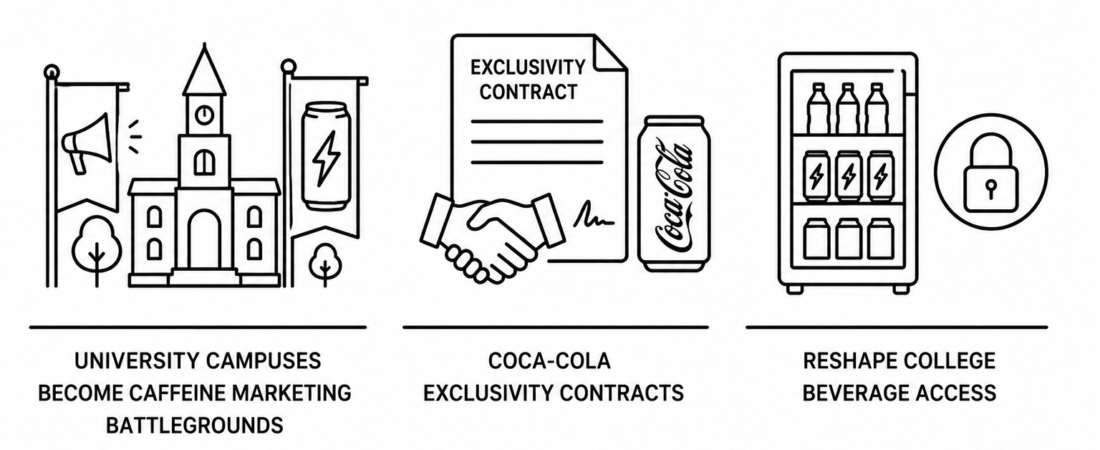
According to a May 21 Chicago Maroon investigative report, university campuses are increasingly functioning as a distinct caffeine regulatory environment, with on-campus beverage availability shaped by exclusivity contracts that determine which brands students can purchase. According to the report, most universities in Illinois have signed contracts requiring university-owned dining halls, cafes, and even vending machines to exclusively sell Coca-Cola products, which include Monster Energy. The arrangement effectively channels student caffeine consumption toward specific brands, with implications for how energy drink companies pursue what the report calls campus market share.
UChicago Documented as the Most Caffeinated Campus in the United States
According to Grubhub data referenced in the Chicago Maroon coverage, University of Chicago students order 138 percent more caffeinated beverages than the national average, making it the most caffeinated campus in the United States by that metric. According to the report, the data point does not include caffeine purchased from campus cafes or distributed through club sponsorships — meaning the actual on-campus caffeine consumption pattern is likely even more concentrated than the Grubhub data suggests. The reporting illustrates how high-cognitive-demand environments can normalize caffeine consumption at levels well above general population averages.
Energy Drink Sponsorships of Student Organizations Become a Regulatory Question
According to the same May 21 reporting, Red Bull and similar energy drink brands have become significant sponsors of registered student organizations (RSOs) — providing free product to student events in exchange for brand visibility and consumption pattern formation. According to the report, the arrangement raises questions about whether university policies should treat energy drink sponsorships differently from other corporate event sponsorships. The pattern is now under active discussion across multiple campus journalism investigations, with implications for how higher education institutions structure their policies on caffeine-product marketing to undergraduate populations.
Montana SNAP Restrictions Add to the Broader Caffeine Regulatory Pattern
According to a May 19 Western Ag Network report referenced in the May 21 coverage, Montana has received federal approval to restrict SNAP food assistance program purchases on sugary drinks, candy, junk food, and energy drinks — placing the state among the first U.S. jurisdictions to use SNAP as a public-health lever against high-caffeine products. According to broader industry analysis, the combination of campus exclusivity scrutiny, SNAP restrictions, and the May 20 Loma Linda University pediatric guidance suggests the regulatory environment for high-caffeine products is fragmenting along multiple new policy dimensions simultaneously through the remainder of 2026.
Jiggle is positioned outside the energy drink, campus-exclusivity, and SNAP-restriction regulatory pressure zones the May 21 Chicago Maroon and adjacent coverage described. The product is sold through direct-to-consumer channels at $18.99 per 12-pack and through independent retail partners, avoiding the campus exclusivity contracts that funnel consumption toward specific high-caffeine brands. With caffeine sourced from green tea extract and guarana, no artificial ingredients, GMP certification, and dose transparency per gummy, the product reflects the adult, ingredient-aware market the regulatory environment is now consolidating around. Learn more at jiggle.cafe.
Policy analysts note that the intersection of campus exclusivity contracts, SNAP restrictions, and pediatric energy drink guidance represents a meaningfully fragmented regulatory environment, and that operators in the high-caffeine product category should expect continued state-level policy variation and corresponding distribution complexity through the remainder of the decade.