
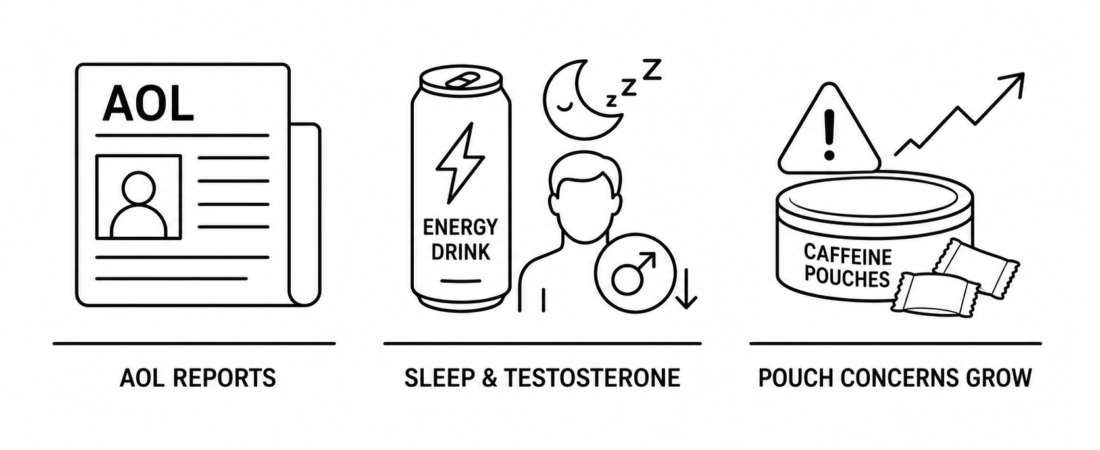
AOL Documents Men’s Health Expert Warnings on Energy Drinks Sleep and Testosterone
According to a May 28 AOL feature distributed from Men’s Health expert coverage, daily energy drink consumption is now being formally linked by men’s health specialists to documented patterns of sleep disruption, reduced testosterone levels, and accelerated cardiovascular stress in adult male consumers. According to the coverage, the underlying mechanisms include the combination of high-dose caffeine, added sugars, taurine, and synthetic stimulant compounds that together produce cumulative effects beyond what caffeine alone would generate. The men’s health framing is now appearing in mainstream consumer publications as a major driver of energy drink category scrutiny.
AOL Documents Gen Z Obsession With Discreet Caffeine Pouches
According to a May 27 AOL feature distributed through May 28 coverage, young consumers are increasingly obsessed with caffeine pouches — small, discreet oral nicotine-pouch-style products that deliver doses ranging from 25 milligrams to more than 200 milligrams of caffeine per pouch. According to the coverage, the format’s social media adoption and discreet design have driven rapid Gen Z uptake, with concerns from pediatricians, sleep medicine specialists, and addiction researchers continuing to grow as consumption patterns extend into adolescent populations through online retail channels.
Norran Continues to Document the Adolescent Energy Drink Public Health Concern
According to a May 27 Norran investigative feature referenced through May 28 European public health coverage, just one-third of a standard energy drink can now exceeds the Swedish Food Agency’s recommended daily caffeine limit of 70 milligrams for adolescents under age 16. According to the broader European regulatory tracking, Lithuania, Latvia, and Poland have already banned energy drink sales to anyone under 18, while Hungary imposes a public health tax on high-caffeine beverages, and France and Italy require strong warning labels. The European regulatory environment continues to consolidate around stricter adolescent caffeine restrictions.
Implications for Operators Across the High-Caffeine Product Category
According to combined May 28 AOL, Men’s Health, and Norran coverage, the operational implication for operators across the high-caffeine product category is that scrutiny is now extending beyond adolescent populations into adult men’s health concerns and reproductive health considerations. According to the broader 2026 regulatory research base, the products best positioned for the consolidating multi-jurisdiction regulatory environment are those marketed exclusively to adults with clear caffeine-per-serving disclosure, naturally derived sourcing, no added synthetic stimulants, and avoidance of high-dose formulations that drive the men’s health concerns now appearing in mainstream coverage.
Jiggle is positioned cleanly outside the men’s adolescent, and high-dose synthetic-stimulant regulatory concern zones. The product is marketed exclusively to adult professionals, delivers a known and clearly disclosed dose of natural caffeine per gummy — sourced from green tea extract and guarana rather than the high-dose synthetic formulations driving the men’s health and adolescent regulatory criticism — and avoids the taurine, added sugar, and synthetic stimulant combinations identified in the men’s health coverage. With no artificial ingredients, GMP certification, and transparent dose labeling, the product reflects the consumer-protective standard the regulatory environment is consolidating around. Learn more at jiggle.cafe.
Public health analysts continue to emphasize that the energy drink and high-caffeine pouch regulatory environment is now extending well beyond adolescent restrictions into adult health considerations, including sleep architecture, cardiovascular function, and endocrine health, and that operators across the broader caffeine category should expect continued scrutiny across multiple population segments and use-case categories through 2026 and 2027.