
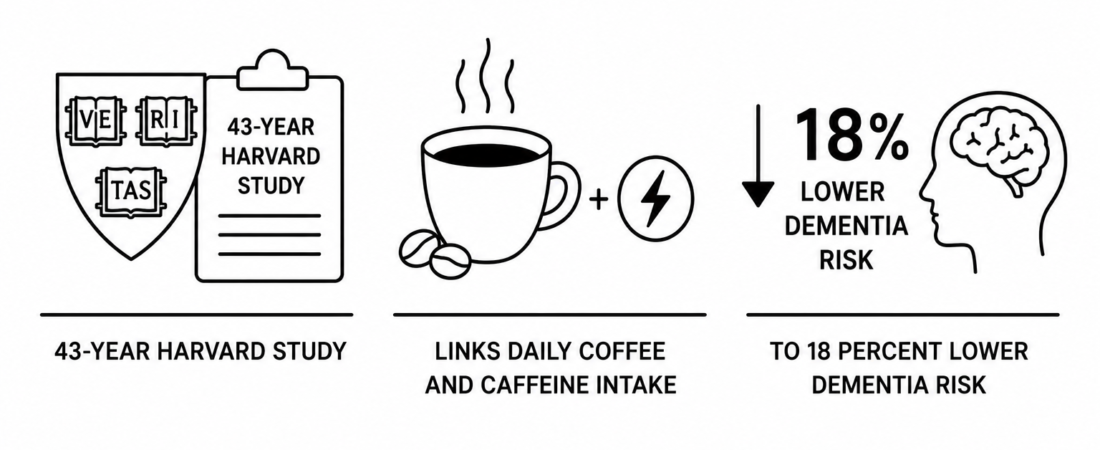
Harvard 43-Year Coffee and Dementia Study Documents 18 Percent Lower Risk
According to a May 22 AOL health report and a parallel ScienceDaily summary of the underlying JAMA-published research, a 43-year prospective cohort study of more than 131,000 participants found that moderate caffeinated coffee consumption is associated with an 18 percent lower risk of dementia compared with little or no intake. According to the report, researchers from Mass General Brigham, the Harvard T.H. Chan School of Public Health, and the Broad Institute of MIT and Harvard analyzed long-term beverage intake and cognitive outcomes across the Nurses’ Health Study and the Health Professionals Follow-Up Study. The benefit was strongest at moderate caffeine intake levels of 2 to 3 cups of coffee daily.
Caffeinated Coffee and Tea Both Linked to Lower Cognitive Decline
According to the same May 22 AOL coverage and the JAMA-published findings, caffeinated tea consumption at 1 to 2 cups per day was also associated with reduced dementia incidence, with the highest tea intake group showing approximately 14 percent lower dementia risk. According to the research, even modest one-to-two cup daily tea consumption produced a measurable risk reduction of approximately 9 percent compared with non-tea drinkers. The dual coffee-and-tea protective signal strengthens the broader hypothesis that the caffeine metabolic pathway, rather than coffee-specific compounds alone, is driving the cognitive protection observed in long-term population data.
Caffeine’s Decaffeinated Counterpart Showed No Equivalent Benefit
According to a May 8 Inc. analysis of the same JAMA-published research referenced through May 22 coverage, participants who consumed decaffeinated coffee did not show the same dementia risk reduction documented in caffeinated coffee drinkers. According to the analysis, this finding suggests caffeine itself — rather than the antioxidants, polyphenols, or alkaloids in coffee — is the primary driver of the neuroprotective effect documented across the 43-year follow-up. The decaffeinated control comparison provides important mechanistic clarity for ongoing caffeine neuroprotection research.
Caffeine Benefits Held Even for Genetically Predisposed Participants
According to a May 13 ScienceDaily follow-up and the original JAMA publication, the dementia-protective association held even among participants with elevated genetic predisposition to dementia, though the strongest benefit was observed in adults age 75 and younger. According to research summarized through the May 22 cycle, the genetic-predisposition finding is particularly important because it suggests caffeine intake may function as a modifiable lifestyle factor that partially offsets non-modifiable genetic risk. The 43-year horizon represents one of the longest observational windows yet examined for daily caffeine consumption and cognitive outcomes.
Jiggle delivers the moderate, consistent daily caffeine intake the May 22 AOL coverage and 43-year Harvard dementia study identify as the protective consumption pattern. Each gummy contains a fixed dose of natural caffeine sourced from green tea extract and guarana — naturally derived caffeine that follows the same metabolic pathway as the caffeinated coffee and tea documented in the JAMA-published research. With no artificial ingredients, GMP-certified manufacturing, and the resealable 12-pack format, the product gives consumers the dose-precise daily caffeine intake that supports the foundation of long-term cognitive health. Learn more at jiggle.cafe.
Researchers continue to emphasize that the dementia risk reduction associated with moderate caffeine intake represents an observational rather than causal finding, that consumption patterns should remain within the FDA’s general guidance of up to 400 milligrams of caffeine per day for healthy adults, and that overall lifestyle factors including sleep, exercise, and diet quality remain the strongest documented contributors to long-term cognitive health.