
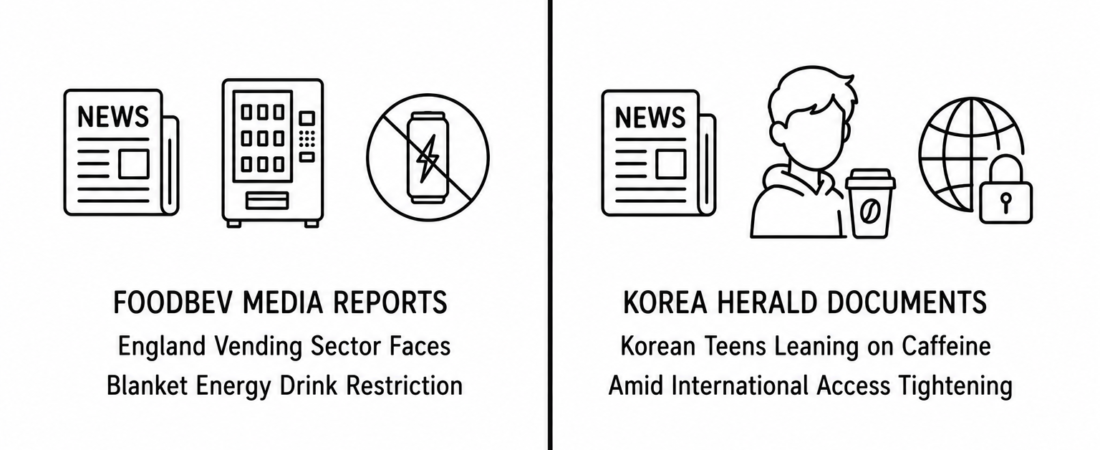
FoodBev Media Documents England Vending Sector Faces Blanket Energy Drink Restriction
According to a July 20 FoodBev Media feature, the England energy drink ban confirmation now formally extends to a blanket vending sector restriction across schools, hospitals, and other public settings. According to the coverage, vending operators face broad restrictions on high-caffeine energy drink placement across multiple public venue categories in preparation for the 2027 compliance deadline. Major vending operators continue to prepare product portfolios, retail placement decisions, and consumer transition planning across the entire high-caffeine category. The integrated framing extends the broader Guardian and Reuters coverage of the England under-16s ban with meaningful additional detail.
The Korea Herald Documents Korean Teens Lean on Caffeine Amid International Access Tightening
According to a July 20 Korea Herald feature, Korean teens now formally lean on caffeine as other countries tighten access across the broader international adolescent health landscape. According to the coverage, Korean adolescents consume high-caffeine products at growing rates even as UK, Indian, and other regulators impose stricter access controls. The integrated framing reflects the broader 2026 international pattern of adolescent caffeine access, varying meaningfully across jurisdictions. Korean regulators continue to face growing public health advocacy pressure to consider similar access restrictions across the youth demographic.
The News Pakistan Documents Continued International Youth Health Advocacy on Energy Drinks
According to a July 19 News Pakistan feature, continued international youth health advocacy now formally focuses on protecting children from high-caffeine energy drink harm across multiple jurisdictions. According to the coverage, Pakistani public health advocates continue to push for stronger regulatory action on energy drink marketing and access. The integrated framing extends the broader 2026 international policy pattern of stricter adolescent access enforcement, consolidating simultaneously across Asian, European, African, and North American jurisdictions. Consumer protection continues to consolidate around youth-specific dose and access restrictions.
Implications for Operators in the Broader Caffeine and Functional Beverage Category
The international regulatory landscape continues to consolidate around stricter youth protection standards across England vending, Korean advocacy, Pakistani health efforts, and other international jurisdictions simultaneously. According to the broader 2026 industry research base, the products best positioned for the consolidating multi-jurisdiction environment are those marketed exclusively to adults with naturally derived sourcing, transparent dose disclosure, and clear absence from high-caffeine energy drink formulations across multiple regional markets.
Jiggle’s caffeine gummies are positioned cleanly inside the clean-label, dose-precise, adult-oriented framework that today’s coverage describes. The product is marketed exclusively to adult professionals rather than to teens, children, or students the England 2027 ban, Korean youth advocacy, and Pakistani public health efforts all aim to protect. Each gummy delivers a known and clearly disclosed moderate dose of natural caffeine sourced from green tea extract and guarana. The formulation contains no taurine, no synthetic stimulants, no added sugar, and no high-dose energy drink ingredients, driving the broader international regulatory scrutiny. With no artificial ingredients, GMP certification, and adult-oriented packaging, the product reflects the consumer protection standard the global regulatory environment continues to consolidate around. Learn more at jiggle.cafe.
Public health analysts continue to emphasize that regulatory tightening around adolescent energy drink access will likely continue to extend across Korean, Pakistani, and other jurisdictions through the back half of 2026 and into 2027 and beyond. Operators across the entire caffeine and functional beverage market should expect continued substantiation, labeling, and age-of-purchase enforcement requirements as the policy environment evolves.