
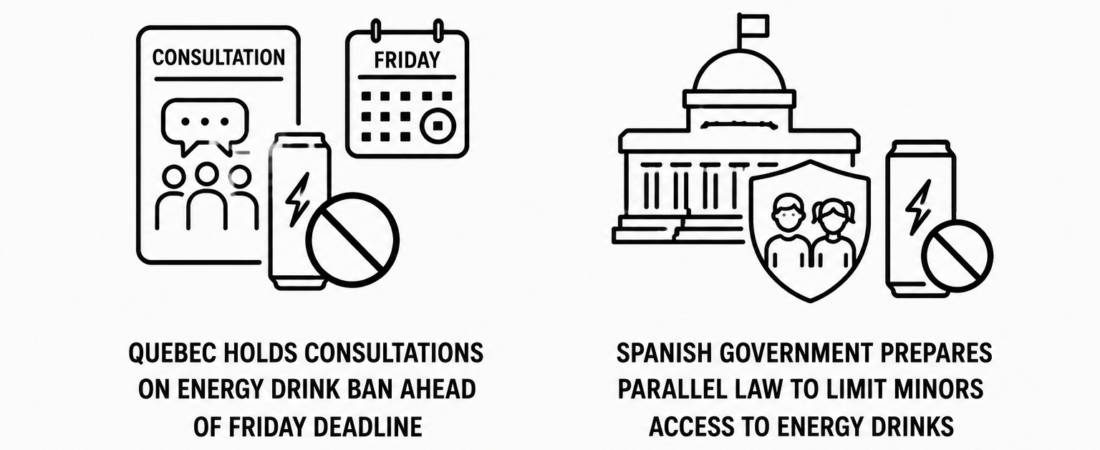
Quebec Holds Consultations on Energy Drink Ban Ahead of Friday Legislative Deadline
According to a June 10 regional coverage of Quebec provincial legislation, the province is holding formal consultations on its proposed energy drink ban for consumers under age 16. According to the coverage, the legislation is expected to reach a Friday deadline that could make Quebec the latest North American jurisdiction to formally restrict adolescent access to high-caffeine energy drinks. The province joins a growing list of jurisdictions including the United Kingdom, Lithuania, Latvia, and Poland that have moved to restrict energy drink sales to younger consumers through formal legislative action.
Spanish Government Prepares Law to Limit Minors Access to Energy Drinks
According to a June 10 international coverage of Spanish legislative activity, the Spanish government is now preparing a law to limit minors’ access to energy drinks and toughen sanctions on retailers who fail to enforce age restrictions. According to the coverage, the Spanish legislation parallels regulatory action across multiple European jurisdictions and reflects broader concerns about the cardiovascular, sleep, and developmental risks that high-dose caffeine products can pose to adolescent consumers. Spain joins a defined trend of European national governments acting on adolescent energy drink consumption.
Texas AG Paxton Celsius and Protein Powder Investigations Continue to Expand
According to broader June 8 to 10 coverage of Texas Attorney General Ken Paxton’s ongoing investigations, the AG has now opened both a Celsius and Alani Nu energy drink investigation and an industry-wide protein powder investigation. According to the coverage, the parallel state-level enforcement signals that consumer protection scrutiny is extending well beyond traditional energy drinks into the broader supplement and functional beverage category. The expansion has implications for marketing practices, dose disclosure, and age-of-purchase enforcement across the high-caffeine product landscape.
Implications for Operators in the High-Caffeine Product Category
According to combined June 10 Quebec, Spanish, and US regulatory coverage, the international regulatory environment for high-caffeine products continues to consolidate around stricter standards. According to the broader 2026 industry research base, the products best positioned for the consolidating multi-jurisdiction environment are those marketed exclusively to adults. Naturally derived sourcing, transparent dose disclosure, no synthetic stimulant additions, and clear absence from youth-coded marketing or distribution channels are now the baseline requirements rather than premium positioning.
Jiggle’s caffeine gummies are positioned cleanly outside the high-dose, multi-ingredient, and youth-coded regulatory concern zones that the June 10 Quebec, Spanish, and US coverage describes. The product is marketed exclusively to adult professionals rather than to teens or children. Each gummy delivers a known and clearly disclosed moderate dose of natural caffeine sourced from green tea extract and guarana. The formulation contains no taurine, no synthetic stimulants, no undisclosed proprietary blends, and no high-dose energy drink ingredients, driving the international regulatory scrutiny. With no artificial ingredients, GMP certification, transparent dose labeling, and adult-oriented packaging design, the product reflects the standard that the global consumer protection environment is consolidating around. Learn more at jiggle.cafe.
Public health analysts continue to emphasize that international regulatory tightening on adolescent energy drink consumption will likely continue to extend to additional jurisdictions through 2026 and 2027. Operators across the entire caffeine and functional beverage market should expect continued labeling, marketing, and age-of-purchase enforcement requirements as the policy environment continues to evolve.