
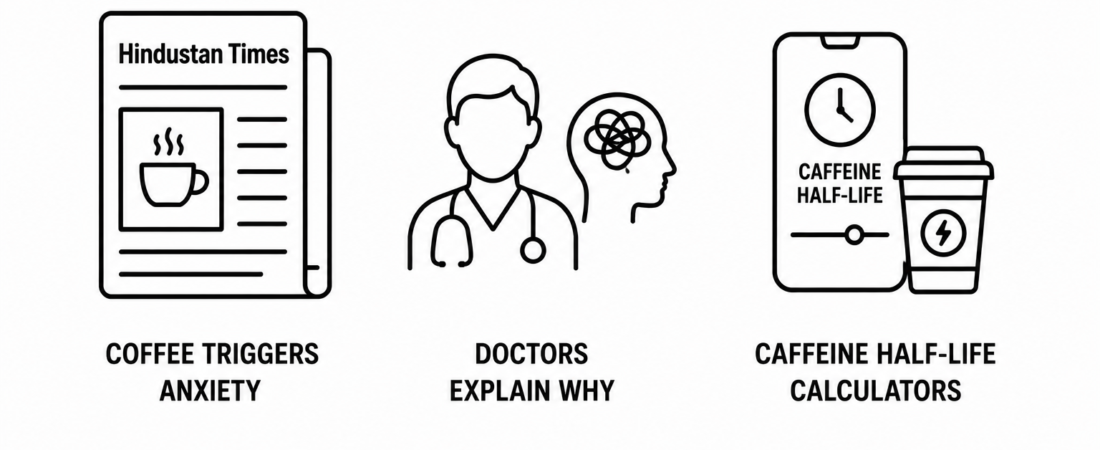
Hindustan Times Documents Why Coffee Triggers Anxiety in Some Consumers
According to a June 8 Hindustan Times health feature, doctors are now formally explaining why coffee can make some consumers feel anxious — connecting the documented adenosine receptor antagonism mechanism that drives caffeine’s stimulant effect to the parallel cortisol elevation, heart rate increase, and central nervous system activation that can present as anxiety symptoms in caffeine-sensitive individuals. According to the coverage, the doctor commentary frames the response as a normal physiological consequence of caffeine’s pharmacology rather than as evidence of underlying anxiety disorder — with dose adjustment, timing changes, and food pairing typically resolving the pattern.
Trend Hunter Documents Caffeine Half-Life Calculator Tools Reaching Mainstream Adoption
According to a June 7 Trend Hunter feature on caffeine tracking tools, caffeine half-life calculators are now functioning as mainstream consumer productivity tools that allow daily caffeine consumers to reverse-engineer their intake around target sleep onset times. According to the broader caffeine pharmacology research base referenced through the coverage, the standard model uses a 5-hour half-life for healthy adults, with individual adjustment for body weight, pregnancy status, smoking status, oral contraceptive use, and CYP1A2 genetic variation — all factors that can substantially shift caffeine clearance rates across the population.
AOL Documents New Research on What Caffeine Actually Does to Sleep
According to a June 7 AOL.com feature distributed through June 8 consumer wellness summaries, scientists have refined the consumer understanding of caffeine and sleep across multiple recent research publications — documenting that caffeine consumption can meaningfully disrupt the architecture of deep sleep even in consumers who appear to sleep their full eight hours each night. According to the broader sleep medicine research base, the slow-wave deep sleep reduction was documented even in consumers who reported subjectively feeling fine the following day, supporting the broader 2026 trend toward consumer caffeine timing awareness as a core sleep hygiene practice.
What the Caffeine Awareness Trend Means for the Coffee Category
According to combined June 8 Hindustan Times, Trend Hunter, and AOL coverage, the operational implication for the broader caffeine category is that consumer purchase decisions are increasingly being driven by dose transparency, personal metabolism awareness, and integrated sleep hygiene considerations rather than by brand marketing alone. According to the broader 2026 wellness category research base, the brands gaining the most durable consumer preference are those that support transparent education, dose-precise consumption, and consumer tools that empower informed daily caffeine decision-making across the full daily routine.
Jiggle’s caffeine gummies align with the dose-transparency, awareness-based caffeine consumption pattern today’s coverage collectively describes. Each gummy contains a known, fixed dose of natural caffeine sourced from green tea extract and guarana — making it straightforward for caffeine-sensitive consumers to plug consumption into a half-life calculator, calibrate intake to personal CYP1A2 metabolism rate, manage anxiety-related sensitivity through dose adjustment, and maintain the consistent moderate daily intake the broader sleep and cardiovascular research base treats as compatible with long-term health outcomes. With no artificial ingredients, GMP-certified manufacturing, and the resealable 12-pack format, the product supports the educated, research-aware caffeine consumer the broader wellness coverage now identifies as the fastest-growing segment. Learn more at jiggle.cafe.
Wellness analysts continue to emphasize that caffeine-related anxiety patterns and sleep architecture sensitivity vary substantially across individuals based on CYP1A2 enzyme activity, habitual intake levels, baseline stress, and overall sleep hygiene, and that consumers experiencing persistent anxiety symptoms should consult a healthcare provider rather than relying on general population research recommendations alone.