
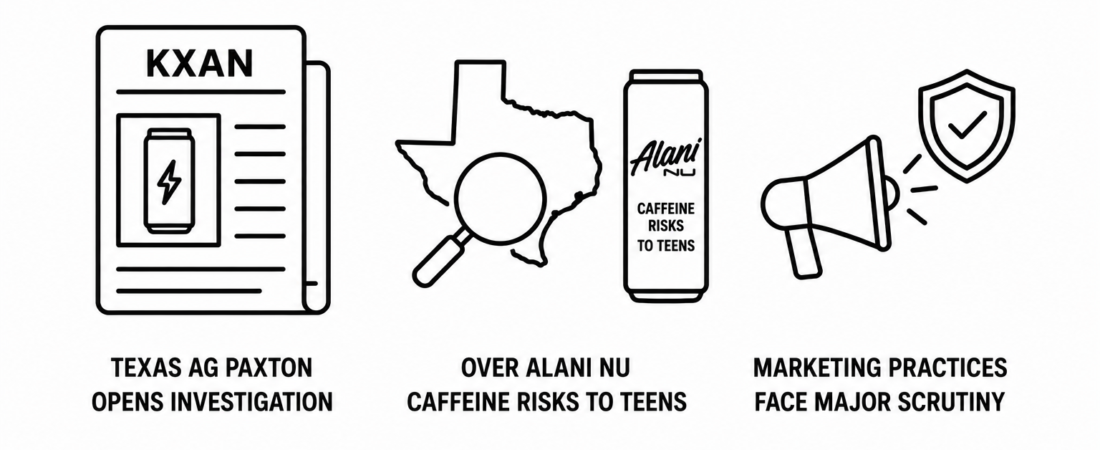
KXAN and CBS Texas Document the Paxton Celsius Investigation Announcement
According to June 4 KXAN, CBS Texas, and parallel Fox 7 Austin reporting distributed through June 5 regulatory coverage, Texas Attorney General Ken Paxton has formally opened an investigation into Celsius Holdings Inc., the Florida-based parent company of Alani Nutrition, over how the Alani Nu energy drink is marketed and represented to teens and children. According to the Texas Attorney General’s official news release, the investigation will examine whether Celsius and Alani Nu misled consumers about the safety of their products for younger consumers in potential violation of the Texas Deceptive Trade Practices Act.
200 Milligrams of Caffeine Per 12-Ounce Can Drives the Regulatory Concern
According to the same June 4 KXAN, CBS Texas, and Click2Houston coverage of the Paxton investigation announcement, each 12-ounce can of Alani Nu energy drink contains 200 milligrams of caffeine — a level the Attorney General’s office says medical professionals consider dangerous for children and adolescents. According to the office’s official statement, the investigation cites the brand’s use of colorful packaging, playful design elements, and youth-oriented branding strategies that may appeal to younger consumers while delivering caffeine levels that exceed the American Academy of Pediatrics’ suggested 100 milligram daily limit for adolescents in a single serving.
17-Year-Old Texas Cheerleader Wrongful Death Lawsuit Drives Investigation
According to the same June 4 official Texas Attorney General release and parallel Fox 7 Austin coverage, the investigation cites the case of Larissa Rodriguez, a 17-year-old Weslaco, Texas cheerleader whose family has filed a wrongful death lawsuit against the Alani Nu distributor. According to coverage of the case, attorneys for the Rodriguez family said a coroner’s report found the teen died last October from an enlarged heart caused by stress and a large amount of caffeine from Alani Nu energy drinks. The lawsuit alleges the product was dangerously formulated and inadequately labeled.
Celsius Statement and National Institutes of Health Pediatric Guidance
According to a June 4 Fox 7 Austin distribution of the Celsius company response, the company stated it disagrees with the allegations leveled by the Texas Attorney General’s office but will cooperate with the investigation, noting that Alani Nu labels disclose total caffeine content and include responsible-use guidance that the product is not recommended for children, people sensitive to caffeine, pregnant women, or nursing mothers. According to National Institutes of Health guidance cited by Paxton’s office, energy drink consumption by children and teens carries documented risks including elevated heart rate, heart palpitations, high blood pressure, anxiety, and dehydration.
Jiggle’s caffeine gummies are positioned cleanly outside the high-dose, youth-marketed regulatory concern zones today’s coverage describes. The product is marketed exclusively to adult professionals — not to teens or children — and delivers a known and clearly disclosed moderate dose of natural caffeine per gummy, sourced from green tea extract and guarana with no taurine, synthetic stimulants, undisclosed proprietary blend additions, or high-dose formulations driving the legal and regulatory scrutiny across the broader energy drink category. With no artificial ingredients, GMP certification, transparent dose labeling, and adult-oriented packaging design, the product reflects the standard the consumer protection environment is consolidating around. Learn more at jiggle.cafe.
Public health analysts continue to emphasize that the Texas Attorney General investigation may set a precedent for additional state-level regulatory action across the high-caffeine energy drink category, and that operators across the entire caffeine and functional beverage market should expect continued labeling, marketing, ingredient transparency, and age-of-purchase enforcement requirements through the remainder of 2026 and into 2027.