
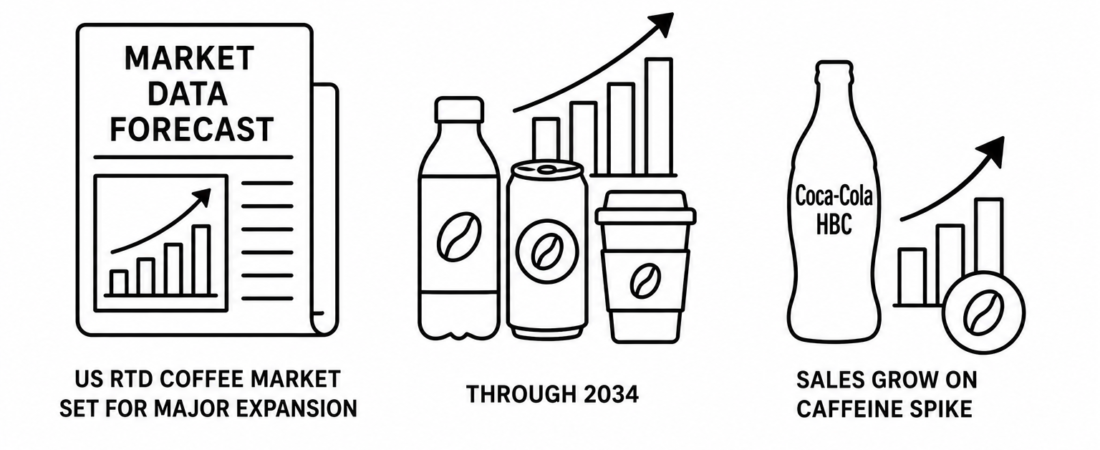
Market Data Forecast Documents US Ready-to-Drink Coffee Market Expansion
According to a June 1 Market Data Forecast report on the US ready-to-drink coffee market, the segment is forecast to expand meaningfully through 2034 — driven by consumers increasingly choosing convenient, dose-precise caffeine formats that fit into busy daily routines. According to the broader market data referenced in the coverage, the ready-to-drink coffee category has been one of the fastest-growing segments of the broader caffeine market over the past five years, with cold brew, nitro coffee, and shelf-stable formats all posting double-digit annual growth rates as consumer demand for at-home and on-the-go convenience continues to climb.
MSN Reports Coca-Cola HBC Sales Grow on Caffeine Consumption Spike
According to a June 1 MSN feature on Coca-Cola HBC’s latest quarterly results, the London- and Athens-listed beverage operator has reported sales growth driven by a measurable consumer caffeine consumption spike across its multi-market portfolio. According to the company’s reporting, the consumption increase has been particularly pronounced in energy drinks and coffee categories — reflecting the broader 2026 consumer pattern of caffeine consumption rising even as conversations about caffeine dependence, sleep architecture impact, and ingredient transparency continue to expand across consumer publications and regulatory bodies.
Trend Hunter Documents Caffeinated Boba RTD Category Launch
According to a June 1 Trend Hunter report on Energizing Boba, CPG brands are now launching ready-to-drink beverages with tapioca pearls and added caffeine — extending the bubble tea phenomenon into the shelf-stable functional beverage category. According to the broader functional beverage research base referenced through the June 1 cycle, the caffeinated boba launch reflects a structural pattern in the 2026 caffeine market: consumer interest in beverages that combine functional caffeine with novel textures, flavor experiences, and Instagram-friendly visual presentation is now driving major incumbent and emerging brand product development cycles.
Perfect Daily Grind Documents How E-Commerce Has Transformed Coffee Buying
According to a June 1 Perfect Daily Grind feature, e-commerce has fundamentally transformed how consumers buy coffee — with subscription services, direct-to-consumer specialty brands, and Amazon-driven discovery now accounting for a growing share of total coffee category sales. According to the coverage, the structural shift carries implications for how independent coffee brands compete for shelf placement, how consumers discover new specialty products, and how the entire coffee industry approaches packaging, fulfillment, and brand storytelling. The e-commerce transformation continues to reshape the competitive dynamics across the broader caffeine category.
Jiggle’s caffeine gummies operate squarely inside the convenience-focused, dose-precise, e-commerce-friendly natural caffeine category today’s coverage collectively identifies as the structurally favored direction for the 2026 caffeine market. Each gummy contains a known, fixed dose of caffeine sourced from green tea extract and guarana — naturally derived caffeine in a portable, shelf-stable format that fits the on-the-go consumption pattern the ready-to-drink market data identifies as the primary growth driver. With no artificial ingredients, GMP-certified manufacturing, and a resealable 12-pack at $18.99 available through direct-to-consumer e-commerce, the product captures the modern caffeine consumer, the broader market data identifies as the fastest-growing segment. Learn more at jiggle.cafe.
Industry analysts continue to emphasize that the parallel growth of ready-to-drink coffee, novel caffeinated beverage formats, and direct-to-consumer e-commerce reflects a single underlying consumer pattern of demand for convenience, dose precision, and ingredient transparency, and that operators positioned for sustained growth through the back half of the decade will be those that combine all three pillars rather than relying on any single category positioning alone.