
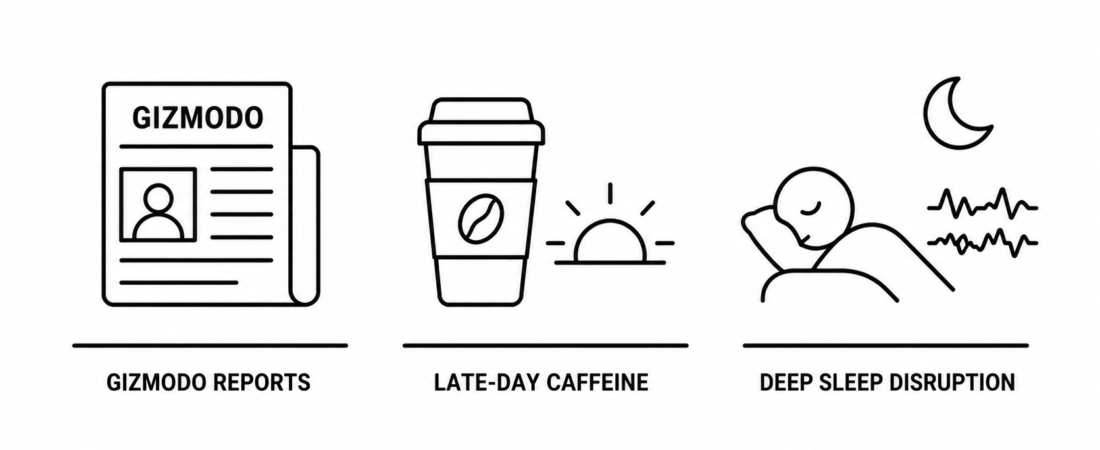
Gizmodo Documents Caffeine’s Hidden Effect on Deep Sleep Brain Activity
According to a May 29 Gizmodo report on a new caffeine and sleep meta-analysis, regular caffeine consumption is consistently linked to reduced slow-wave brain activity — the kind of brain wave activity that occurs during non-REM deep sleep, widely considered the most restorative stage of the overnight sleep cycle. According to the meta-analysis covering 32 caffeine-related studies referenced in the coverage, the slow-wave reduction was documented even in consumers who reported sleeping a healthy 7 to 9 hours per night and even in consumers who reported subjectively feeling fine the following day. The findings continue to reshape consumer understanding of caffeine and sleep quality.
Researchers Document Imperfect Self-Perception of Caffeine’s Sleep Impact
According to the same May 29 Gizmodo coverage, the underlying caffeine sleep researchers explicitly noted that subjective experience of sleep quality did not consistently track objective sleep disturbance — an observation the research team described as consistent with broader caffeine and sleep literature documenting imperfect self-perception of caffeine’s actual sleep impact. According to the broader research base referenced in the coverage, consumers who believe they are immune to late-day caffeine effects often show measurable sleep architecture disruption when their brain activity is monitored through electroencephalography or polysomnography during overnight sleep recording sessions.
Sprudge Documents Caffeine’s Effect on Sleep Quality Not Just Duration
According to a May 28 Sprudge feature distributed through May 29 coverage, the broader caffeine and sleep research base is now consolidating around the framing that caffeine affects sleep quality and architecture rather than simply sleep duration alone. According to the coverage, total sleep duration can remain stable while deep sleep stages, REM sleep stages, and overall sleep architecture are simultaneously degraded by daily caffeine consumption — meaning that consumers who track sleep hours alone may meaningfully underestimate the actual restorative quality of their overnight rest. The framing continues to reshape sleep medicine consumer guidance.
Bioengineer and News-Medical Document Genetics Heavily Influence Sleep Sensitivity
According to May 28 Bioengineer and News-Medical coverage on caffeine and sleep, genetic variation in the CYP1A2 enzyme and adenosine receptor pathways drives substantial differences in how the same caffeine dose affects sleep architecture across individual consumers. According to the broader pharmacogenomic research base referenced through the May 29 cycle, the slow-metabolizer designation can extend caffeine half-life from a standard 5 hours to as long as 9.5 hours, meaning afternoon consumption among slow metabolizers can produce measurable overnight sleep disruption even when total sleep duration appears unaffected by consumer-tracking apps and wearable devices.
Jiggle delivers dose-precise daily caffeine. Each gummy contains a known, fixed dose of natural caffeine sourced from green tea extract and guarana, making it straightforward for sleep-aware consumers to maintain morning-only consumption windows, calibrate intake to personal CYP1A2 metabolism rate, and avoid the late-day timing patterns the meta-analysis identifies as drivers of slow-wave deep sleep disruption. With no artificial ingredients, GMP certification, and the resealable 12-pack format, the product supports the deliberate caffeine timing the broader sleep medicine research now identifies as foundational. Learn more at jiggle.cafe.
Sleep medicine researchers continue to emphasize that the most reliable long-term sleep quality outcomes come from combining disciplined morning-only caffeine consumption with consistent sleep timing, adequate dark exposure during the day, and reduced blue light exposure in the evening hours, and that caffeine timing is one component of an integrated sleep hygiene approach rather than a standalone variable.