
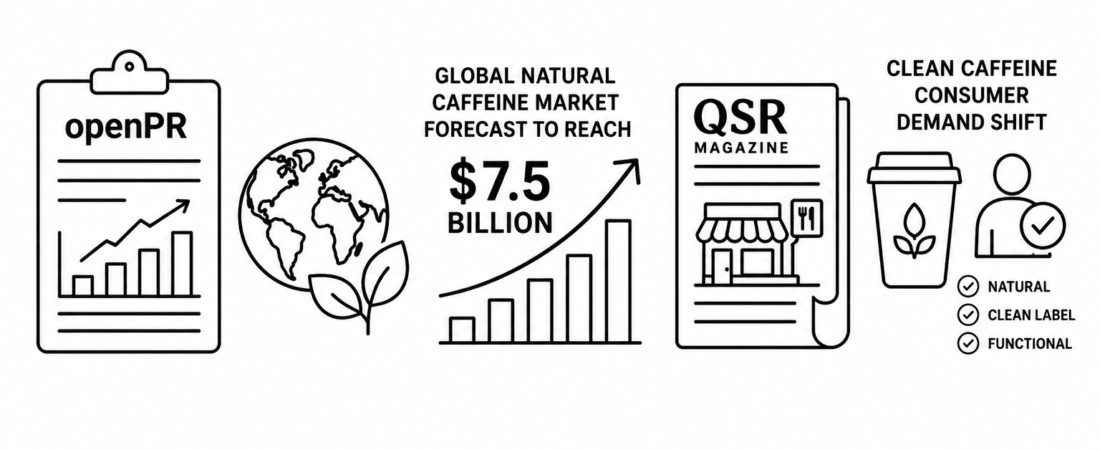
openPR Documents Global Natural Caffeine Market Trajectory Toward $7.5 Billion
According to a May 28 openPR market analysis, the global natural caffeine market is now forecast to reach approximately $7.55 billion through the late 2020s, driven by accelerating consumer demand for caffeine sourced from botanical extracts, including coffee beans, green tea, guarana, and yerba mate. According to the report, sustainability sourcing frameworks are becoming a structural component of the natural caffeine category — with brand operators increasingly required to document supply chain provenance, labor practices, and environmental footprint as conditions of mainstream retail distribution. The market forecast reflects a broader consumer migration away from synthetic caffeine.
QSR Magazine Documents How to Meet Consumers’ Clean Caffeine Goals
According to a May 28 QSR Magazine report on consumer clean caffeine preferences, cold brews, caffeinated refreshers, and functional teas with clean-label claims have become required offerings across mainstream restaurant and quick-service operators. According to the coverage, consumers are using the term clean caffeine to describe caffeine products that are naturally sourced, ingredient-transparent, and free from synthetic stimulants or artificial additives. The clean caffeine framing has now consolidated into a defined consumer purchase criterion that shapes everything from menu development to brand positioning across the quick-service restaurant category.
Indonesia Coffee Production Drop and Brazil Harvest Forecasts Continue to Shape Global Supply
According to broader May 27 Daily Coffee News and Comunicaffe International coverage referenced through the May 28 cycle, Indonesia’s coffee production forecast continues to project an 8 percent decline for the 2026/27 season while Brazil’s record harvest forecasts of 71 to 76 million bags continue to shape global supply expectations. According to combined industry coverage, the dual signals are producing a fragmented coffee price environment — with arabica prices at November 2024 lows on Brazil oversupply while robusta and specialty origins face tighter supply from Indonesia and other Southeast Asian producers.
What the Clean Caffeine Market Shift Means for Operators
According to combined May 28 openPR, QSR Magazine, and adjacent market coverage, the operational implication for caffeine product operators is that natural sourcing, ingredient transparency, and supply chain documentation are now baseline rather than premium positioning. According to the broader 2026 industry research base, the brands gaining the most durable retail share are those that combine naturally derived caffeine sourcing with verifiable sustainability frameworks, clear dose-per-serving disclosure, and clean-label formulation standards. The clean caffeine consumer is now mainstream rather than niche.
Jiggle operates squarely inside the clean caffeine category the May 28 openPR and QSR Magazine coverage collectively identifies as the structurally favored direction for the $7.5 billion natural caffeine market. Each gummy contains a known, fixed dose of caffeine sourced from green tea extract and guarana — botanically derived caffeine that fits the natural sourcing framework the market data identifies as the consumer preference baseline. With no artificial ingredients, GMP-certified manufacturing, and the resealable 12-pack format at $18.99, the product captures the clean caffeine consumer the broader industry data identifies as the fastest-growing segment of the modern caffeine market. Learn more at jiggle.cafe.
Industry analysts continue to emphasize that the natural caffeine and clean caffeine market expansion is being supported by parallel consumer trends, including ingredient transparency, supply chain accountability, and functional benefit pairing, and that operators positioned for sustained growth through the late 2020s will be those that combine all three pillars rather than relying on natural sourcing alone.