
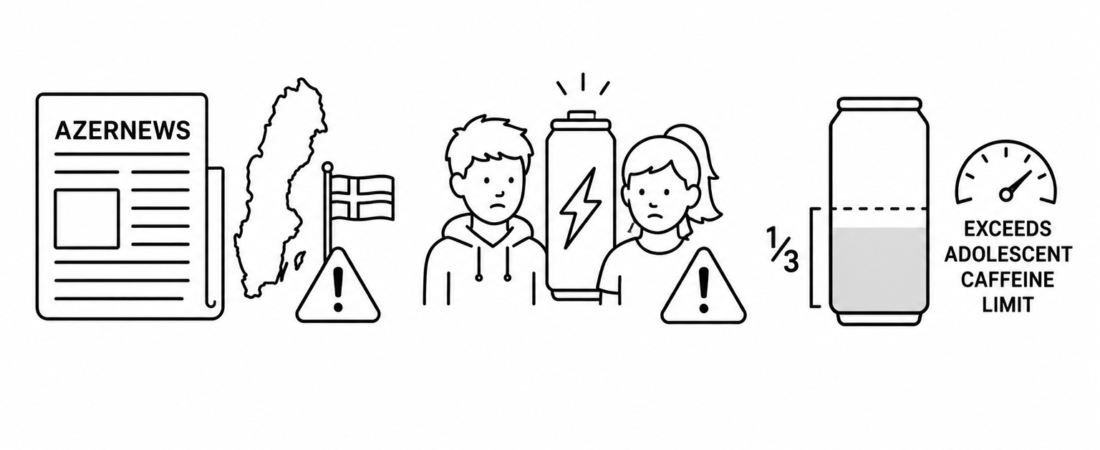
Norran Reports the Stark Truth About Kids and Energy Drinks
According to a May 27 Norran investigative feature distributed through major European publications, just one-third of a standard energy drink can now exceeds the Swedish Food Agency’s recommended daily caffeine limit of 70 milligrams for adolescents under age 16. According to the report, the threshold represents a stark gap between current consumption patterns and recommended safety levels — with a typical 180 to 200 milligram energy drink can delivering more than double the recommended daily caffeine intake for a teenager in a single serving. The reporting continues to elevate adolescent caffeine consumption as a major European public health concern.
AzerNews Documents the Swedish Regulatory Position on Youth Caffeine Consumption
According to a May 27 AzerNews report on the Swedish Food Agency’s adolescent caffeine guidance, the agency has formally recommended that adolescents under age 16 limit daily caffeine intake to no more than 70 milligrams and that children under age 6 avoid caffeine entirely. According to data referenced in the coverage, daily energy drink consumption among Swedish high school students rose from 13 percent in 2021 to 29 percent in 2024 — a doubling of consumption rates that triggered the formal regulatory response. The agency continues to position the guidance as protective of adolescent sleep, cardiovascular development, and academic performance.
Channel Africa Reports New Research on South African Caffeine Sensitivity Patterns
According to a May 27 Channel Africa report on new research into population-level caffeine sensitivity, approximately 10 percent of South African caffeine consumers are now classified as slow metabolizers — a designation associated with elevated risks of anxiety, sleep disruption, and cardiovascular reactivity at standard caffeine doses. According to the broader pharmacogenomic research base referenced in the coverage, CYP1A2 enzyme variation drives the differential metabolism patterns observed across population groups, and the slow-metabolizer designation can extend caffeine half-life from a standard 5 hours to as long as 9.5 hours in affected individuals.
Implications for Operators in the High-Caffeine Product Category
According to combined May 27 Norran, AzerNews, and Channel Africa coverage, the operational implication for operators in the high-caffeine product category is that age-of-purchase enforcement, transparent dose disclosure, and sensitivity-aware product positioning are now baseline regulatory and consumer protection expectations across both European and African markets. According to the broader industry research base, the products best positioned for the multi-jurisdiction regulatory environment now consolidating are those marketed exclusively to adults, with clear caffeine-per-serving labels, naturally derived sourcing, and avoidance of youth-coded marketing or distribution channels.
Jiggle is positioned cleanly outside the adolescent and slow-metabolizer regulatory concern zones the May 27 Norran, AzerNews, and Channel Africa coverage collectively describes. The product is marketed exclusively to adult professionals, delivers a known and clearly disclosed dose of natural caffeine per gummy — sourced from green tea extract and guarana rather than the high-dose synthetic formulations driving global regulatory action — and avoids the youth-coded marketing that has drawn intensifying regulatory criticism across Sweden, Lithuania, Latvia, Poland, Hungary, France, and Italy. With no artificial ingredients, GMP certification, and transparent dose labeling, the product reflects the consumer-protective standard the regulatory environment is consolidating around globally. Learn more at jiggle.cafe.
Public health analysts continue to emphasize that the European and global regulatory tightening on adolescent caffeine consumption is likely to continue extending to additional jurisdictions through 2026 and 2027, and that operators across the broader caffeine category should expect intensifying scrutiny on marketing claims, ingredient disclosure, and age-of-purchase enforcement as the policy environment continues to evolve.