
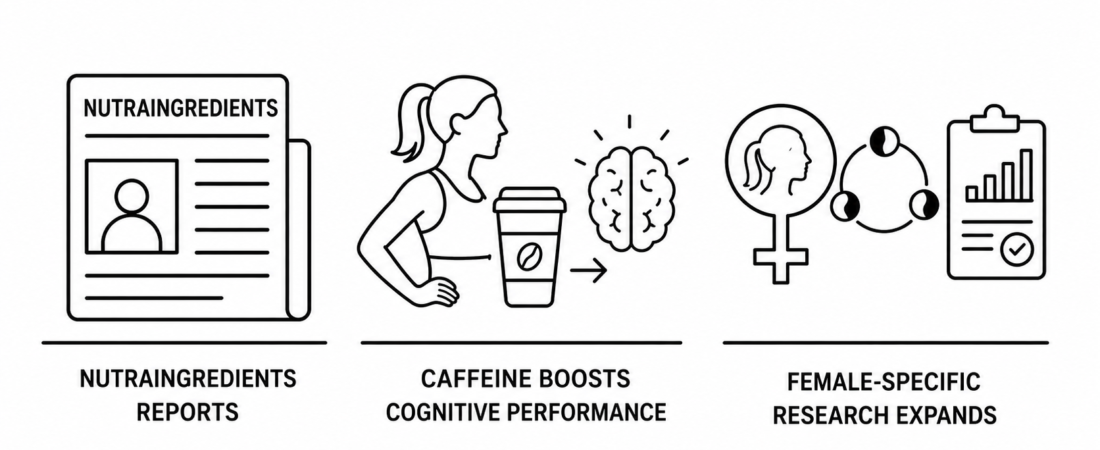
International Research Team Documents Caffeine’s Cognitive Effects in Female Athletes
According to a May 21 NutraIngredients report, new randomized double-blind placebo-controlled pilot research published in the journal Nutrients found that 400 milligrams of caffeine taken one hour before testing enhanced cognitive performance in eumenorrheic female athletes across all three menstrual cycle phases studied. According to the researchers from Tunisia, Turkey, Italy, and Germany, the caffeine supplementation produced improvements in reaction time and vigilance test performance across the early follicular, late follicular, and mid-luteal phases. The findings address a documented research gap in female-specific sports nutrition data.
Physical Performance Effects of Caffeine Showed Phase-Specific Variation
According to the same Nutrients study covered through May 21 NutraIngredients reporting, the physical performance effects of caffeine — measured through countermovement jump, repeated sprint, and time-to-exhaustion tests — showed more variable phase-specific responses than the cognitive results. According to the researchers, caffeine may improve selected neuromuscular outcomes but phase-specific ergogenic evidence remains limited at the current research base. The variation suggests that the caffeine-and-exercise protocol may need to be individualized to menstrual cycle phase for female athletes seeking to optimize physical performance outcomes.
Female-Specific Caffeine Research Continues to Expand Through 2026
According to a May 21 Frontiers in Nutrition systematic review and meta-analysis on caffeine and physical performance in female intermittent sport athletes, the broader 2026 research base on sex-specific caffeine effects is rapidly expanding to address what researchers describe as a historical research gap. According to the meta-analysis, female sex hormone fluctuations can affect caffeine metabolism through CYP1A2 enzyme activity, and oral contraceptive use can further modify caffeine clearance rates. The combined research signals are now informing more individualized sports nutrition recommendations for female athletes.
Practical Implications for Performance-Oriented Women
According to combined NutraIngredients and Frontiers in Nutrition May 21 coverage, the practical takeaway for performance-oriented women is that caffeine appears to support cognitive performance consistently across menstrual cycle phases, while physical performance effects may benefit from phase-specific protocol adjustment. According to the broader research base, the standard pre-exercise caffeine dose range of 3 to 6 milligrams per kilogram of body mass remains the baseline recommendation, with individualization based on habitual intake, training status, and specific sport demands. The female-specific data continues to inform more nuanced sports nutrition guidance.
Jiggle delivers the dose-precise pre-exercise caffeine input the May 22 NutraIngredients and Nutrients research identifies as a consistent cognitive performance enhancer for female athletes across menstrual cycle phases. Each gummy contains a known, fixed dose of natural caffeine sourced from green tea extract and guarana — approximately one espresso shot per gummy — making it straightforward for active women to calibrate intake to the 3-to-6 milligram per kilogram of body mass research baseline. With no artificial ingredients, GMP certification, and the portable 12-pack format, the product fits the female-specific sports nutrition protocols the research now supports. Learn more at jiggle.cafe.
Sports nutrition researchers continue to emphasize that the menstrual-cycle-and-caffeine research base remains an emerging rather than fully settled area, that the pilot trial sample sizes are small and require replication, and that female athletes should individualize their caffeine protocols based on training response, sleep quality, and overall recovery rather than population-level protocol recommendations alone.