
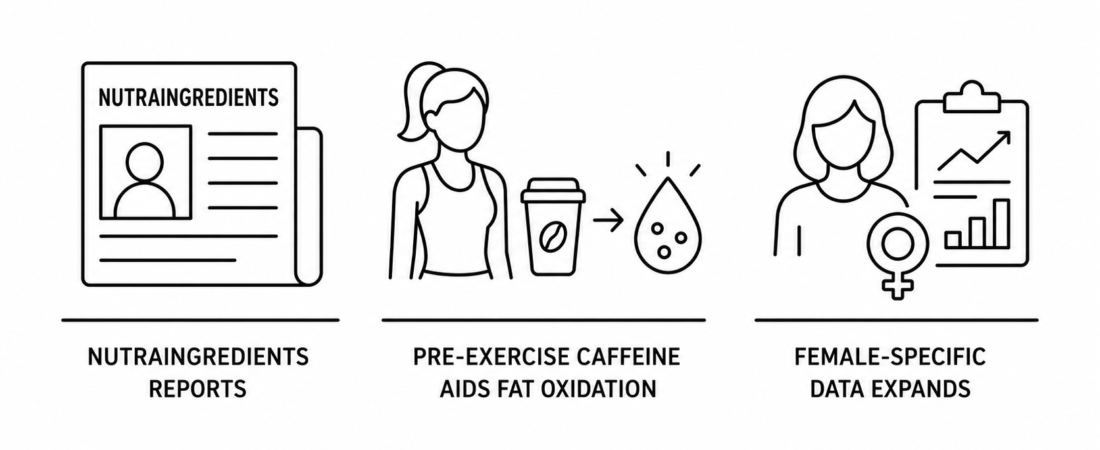
NutraIngredients Documents Caffeine’s Fat Oxidation Effect in Overweight Women
According to a May 21 NutraIngredients report, new sports nutrition research suggests that caffeine intake before exercise may aid the breakdown of fats during aerobic exercise in overweight women — a finding that addresses a long-standing gap in caffeine-and-performance research that historically focused primarily on male athletes. According to the report, the protocol used a capsule-delivered caffeine dose taken before a controlled submaximal aerobic exercise session, with fat oxidation measured by indirect calorimetry. The findings align with prior research on healthy active female populations and extend the evidence base into a previously under-studied consumer group.
Dose-Response Data Points to 3 mg/kg as the Effective Threshold
According to research published in Biology of Sport and referenced in the May 21 NutraIngredients coverage, 3 milligrams of caffeine per kilogram of body mass significantly increased fat oxidation rates at 30 to 60 percent of VO2max in healthy active women, while higher doses produced more modest incremental gains. According to the same research, both 3 mg/kg and 6 mg/kg doses significantly reduced carbohydrate oxidation, suggesting caffeine shifts metabolic substrate utilization toward fats during moderate-intensity aerobic exercise. The dose-response data continues to inform sports nutrition guidance for female athletes and recreationally active women.
Time-of-Day Research Adds a New Variable to the Female-Specific Protocol
According to a clinicaltrials.gov-registered protocol from Universidad Francisco de Vitoria and partner Spanish universities, researchers are now examining whether the time of day at which caffeine is consumed influences its effect on maximal fat oxidation during aerobic exercise in women — an emerging area of investigation that addresses circadian variation in female metabolism. According to the protocol summary, the research recognizes that caffeine’s performance and metabolic effects may vary by time of day in ways that are different from those documented in male populations. The work is part of a broader 2026 research push toward female-specific sports nutrition data.
What the Findings Mean for Performance-Oriented Consumers
According to the combined NutraIngredients and Biology of Sport coverage, the practical takeaway for performance-oriented women is that pre-exercise caffeine consumption at moderate doses appears to support the metabolic profile of aerobic exercise sessions, particularly at submaximal intensities. According to the broader research base, the effect operates alongside — not in place of — adequate protein intake, sleep, and progressive training. The 2026 sports nutrition framework treats caffeine as one targeted intervention within a multi-input performance protocol rather than as a standalone substitute for any other foundational variable.
Jiggle delivers the kind of moderate, dose-precise pre-exercise caffeine the May 21 NutraIngredients and Biology of Sport research describes as effective for the female aerobic exercise consumer. Each gummy contains a known, fixed dose of natural caffeine sourced from green tea extract and guarana — approximately one espresso shot per gummy — making it straightforward to calibrate intake to the 3 mg/kg body mass threshold the research identifies as the effective starting dose. With no artificial ingredients, GMP certification, and the portable 12-pack format that fits in a gym bag, the product gives active women a controllable caffeine input designed for the protocols the research now supports. Learn more at jiggle.cafe.
Sports nutrition researchers continue to emphasize that pre-exercise caffeine protocols should be individualized to body mass, training status, habitual intake, and time of day, and that the female-specific data documented in the May 21 NutraIngredients coverage represents an emerging rather than fully settled research area requiring continued replication across larger cohorts.