
Matcha’s Caffeine Content Documented as Dose-Dependent on Powder Volume
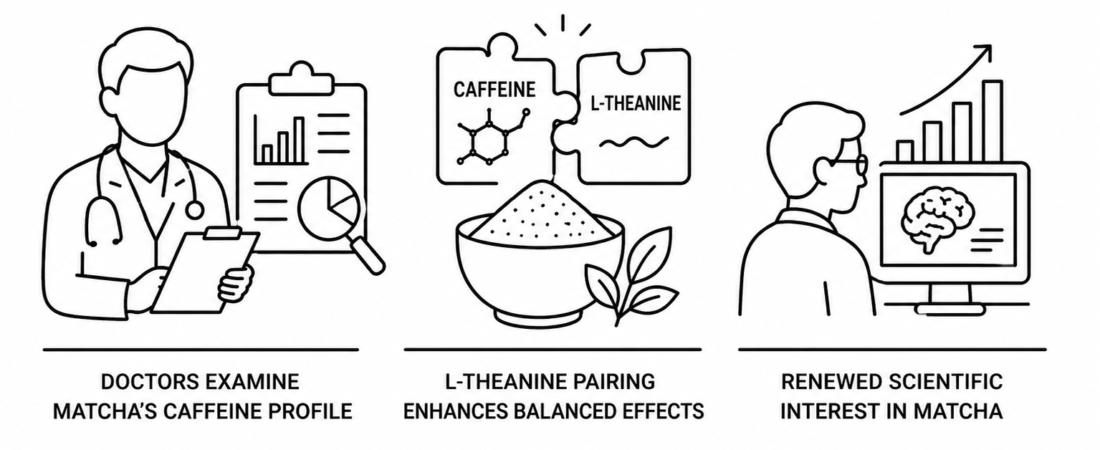
According to a May 20 MSN health report featuring medical commentary, the long-running question of whether matcha contains more caffeine than coffee depends almost entirely on serving size. According to Healthline’s referenced data, matcha contains between 19 and 44 milligrams of caffeine per gram of powder, meaning a standard 2-to-4 gram serving delivers between 38 and 176 milligrams of caffeine. According to the same reference data, an 8-ounce cup of brewed coffee contains roughly 95 to 200 milligrams of caffeine. The May 20 medical analysis confirms that matcha typically delivers less caffeine per serving than coffee, but stronger preparations such as ceremonial-grade Koicha can rival or exceed espresso.
L-Theanine Pairing Produces a Functionally Distinct Caffeine Experience
According to the MSN report and corroborating Healthline coverage, matcha’s caffeine is delivered alongside L-theanine, an amino acid that slows caffeine absorption and modifies its functional effect. According to the analysis, the L-theanine combination is associated with reduced jitters, smoother onset, and what researchers describe as a calmer, more sustained energy curve compared with coffee. According to research summarized in the May 20 coverage, the L-theanine and caffeine pairing has been linked to improvements in attention, mood, memory, and reaction time across multiple controlled studies, helping explain why matcha is increasingly framed as a functional rather than purely stimulant beverage.
Caffeine Half-Life and Metabolism Drive Renewed Consumer Curiosity
According to a separate May 20 Flow Path caffeine metabolism explainer referenced through Google Alerts coverage, caffeine has an average half-life of about 5 hours in healthy adults, meaning a 200-milligram dose at noon still leaves roughly 100 milligrams circulating at 5 p.m. According to the same analysis, individual metabolic rates can shift the half-life from as short as 1.5 hours to as long as 9.5 hours, primarily driven by CYP1A2 enzyme variation. The metabolism science is now appearing in mainstream consumer coverage as readers seek to understand why their morning cup affects sleep differently than their friend’s.
Why Science Matters for the Caffeine Category
According to the broader May 20 coverage across MSN, Flow Path, and Daily Coffee News, the consumer caffeine conversation has shifted decisively from “how much” to “what kind, paired with what, metabolized how.” According to the data, this shift is reshaping which products gain consumer trust: those that disclose caffeine source, pair caffeine with research-backed compounds, and respect the individual variation in metabolism. The matcha L-theanine combination is being studied as a category template — a paired-ingredient model that consumer-facing brands across the energy and functional beverage space are now trying to replicate with synthetic and natural variants.
Jiggle draws its caffeine from green tea extract — the same plant family that produces matcha — and from guarana, giving the product the naturally paired caffeine-and-polyphenol profile the May 20 MSN report describes as the new benchmark for functional caffeine consumers. Each gummy contains a precisely measured dose roughly equivalent to one espresso shot, supporting the individual-metabolism considerations the Flow Path caffeine half-life analysis highlights. With no artificial ingredients and a resealable 12-pack format, the product gives consumers a portable, plant-sourced caffeine option that reflects what the science is now pointing toward. Learn more at jiggle.cafe.
Researchers continue to emphasize that individual caffeine response varies substantially based on genetics, habitual intake, and overall sleep hygiene, and that even well-studied combinations like matcha’s caffeine-and-L-theanine pairing should be considered within the context of total daily stimulant intake rather than as a license for additional consumption