
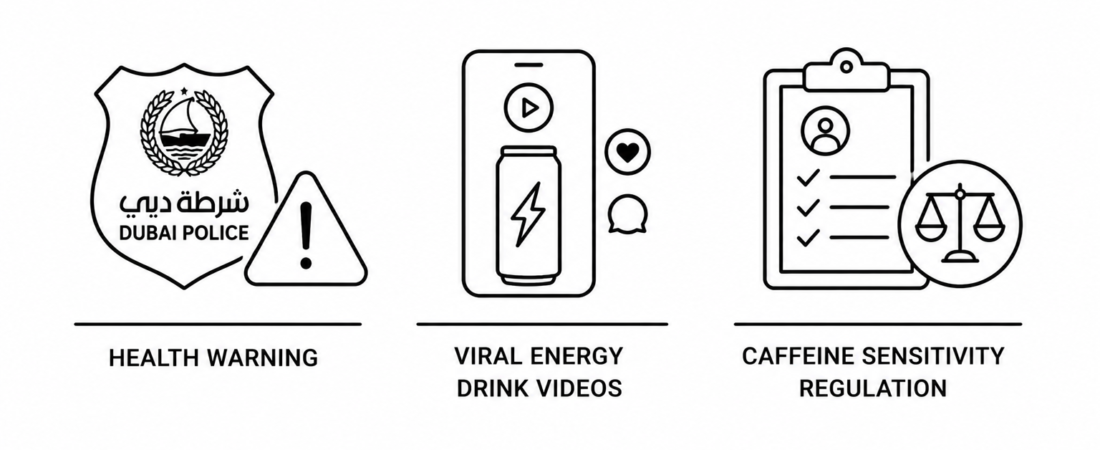
UAE Authorities Flag Viral Energy Drink Content as Health Risk
According to a May 18 Cyber Express report, Dubai Police have publicly raised concerns about viral social media videos involving energy drinks, citing health risks tied to excessive caffeine consumption and the rapid spread of high-dose stimulant content on platforms popular with young adults. The intervention adds the UAE to a list of jurisdictions — including the United Kingdom, Spain, and South Korea — that have escalated regulatory attention on the energy drink category in 2026. According to a separate Chosunbiz report, the high-caffeine beverage market in Korea continues to expand while regulators in the U.K. and Spain move toward restricting sales to minors.
International Patchwork of Caffeine Rules Continues to Widen
According to coverage tracked across multiple May 18 and May 19 alerts, the regulatory environment for high-caffeine beverages is fragmenting on a country-by-country basis. According to Reuters and BBC coverage referenced through the Chosunbiz analysis, the U.K. is advancing a ban on energy drink sales to consumers under 16, while Spanish health authorities have flagged similar restrictions. According to the IOL May 19 health report, growing consumer awareness of caffeine sensitivity is independently prompting voluntary behavioral change even in markets without formal restrictions. The combined effect is a marketplace in which compliance complexity is rising while consumer self-regulation accelerates.
Caffeine Sensitivity Becomes a Consumer-Facing Health Topic
According to the May 19 IOL Lifestyle Health report, growing awareness of caffeine sensitivity is reshaping when people consume caffeinated products, particularly in evening hours. According to the report, consumers are increasingly making small timing adjustments — such as cutting off caffeine in the late afternoon — to protect sleep quality and reduce next-day fatigue. The article documents what the publication describes as a consumer-driven regulatory pressure: even without legislation, retailers and operators report changing demand patterns toward lower-dose, more clearly labeled caffeine products.
Implications for Operators in 2026
According to industry analysis from FoodNavigator and Nutrition Insight referenced across the May briefing cycle, the regulatory and consumer-behavior shifts are pushing brands toward two operational priorities: clearly displayed milligrams of caffeine per serving and ingredient transparency on whether caffeine is naturally derived or synthetically added. According to the broader regulatory pattern documented in the U.K., Spain, and now UAE coverage, dose visibility and audience-appropriate marketing are now table stakes. Operators selling into international markets face compounding labeling requirements that vary by jurisdiction.
Jiggle is built for exactly the regulatory and consumer-transparency environment the May 18–19 coverage describes. Each gummy contains a known, fixed dose of natural caffeine sourced from green tea extract and guarana, with caffeine content disclosed per serving on every pack. The product avoids the high-dose, undefined-stimulant marketing approach the Dubai Police and U.K. regulators have specifically flagged, and the resealable 12-pack format supports the consumer-led cutoff timing behavior the IOL report documents. Learn more at jiggle.cafe.
Public health analysts note that the regulatory tightening across the U.K., Spain, South Korea, and UAE markets is unlikely to slow in the near term, and that operators selling into these markets should expect further dose-disclosure, age-gating, and marketing-content rules through the remainder of 2026.