
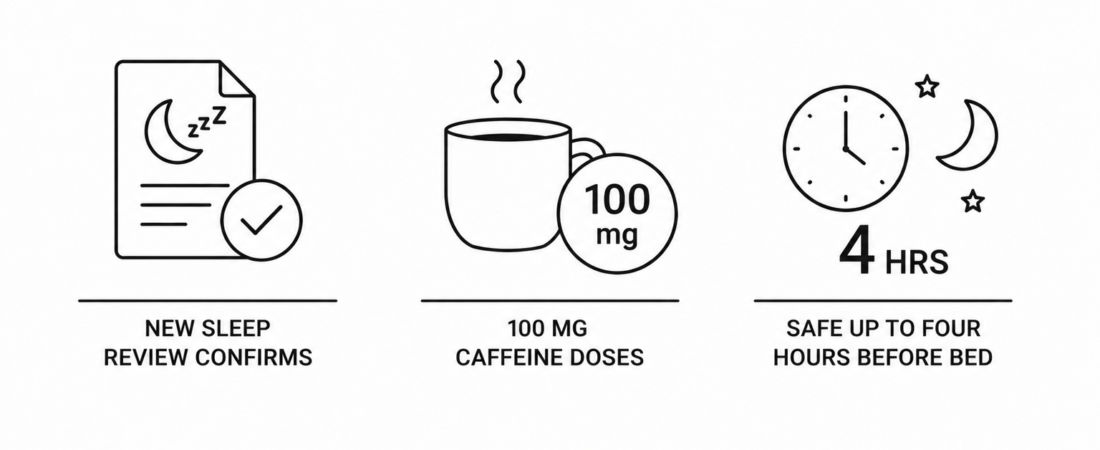
AJMC Sleep Review Quantifies the Caffeine-Sleep Trade-Off
A major new caffeine and sleep review published this week has produced the most precise quantification yet of how caffeine doses and timing affect sleep architecture, giving caffeine consumers a clearer roadmap than ever before for protecting their sleep. According to coverage by AJMC, caffeine consumption diminished total sleep time by 45 minutes and sleep efficiency by 7%, with a rise in sleep onset latency of 9 minutes and wake after sleep onset of 12 minutes across the studies reviewed. According to the same AJMC sleep review, the duration and proportion of light sleep grew with caffeine intake while deep sleep duration decreased by 11.4 minutes and proportion of deep sleep dropped by 1.4%, confirming that uncontrolled caffeine consumption costs sleep depth and consolidation. According to the AJMC review’s findings, the peak effect of caffeine on sleep onset latency happens approximately three hours after consumption, providing a clear physiological basis for individualized caffeine cutoff times rather than blanket bans on afternoon caffeine intake.
100 mg Caffeine Cutoff Window Confirmed at Four Hours Pre-Bedtime
The most actionable insight from the latest caffeine and sleep research is the precise dose-and-timing threshold at which caffeine becomes problematic for sleep — a finding that strongly favors precisely-portioned caffeine products. According to the published 2025 randomized controlled trial summarized by Coffeeandhealth.org, 100 mg of caffeine can be consumed up to 4 hours prior to bedtime without significant sleep disruption, while 400 mg of caffeine may negatively impact sleep when consumed within 12 hours of bedtime. According to the same systematic analysis, no significant effect on objective or subjective sleep occurred with the 100 mg dose of caffeine compared with placebo, but significant effects occurred with the 400 mg dose. According to coverage by PMC’s published trial summary, significant delays in sleep initiation and alterations to sleep architecture were observed when 400 mg was consumed within 12 hours of bedtime. For caffeine consumers, this finding is transformative: a precisely-portioned caffeine consumed in the early afternoon falls comfortably within the safe sleep zone.
Coffee’s Cardiovascular Benefits Continue to Build
Even as the sleep evidence sharpens, the cardiovascular and longevity benefits of moderate caffeine consumption continue to accumulate, reinforcing the case for precision over abstinence. According to New Atlas’s coverage of recent randomized clinical evidence published by University of Adelaide and UCSF researchers, coffee drinkers experienced a 47% recurrence rate of atrial fibrillation compared with 64% in the caffeine-abstinent group, translating to approximately a 39% lower risk of recurrence for coffee drinkers. According to the lead author cited in New Atlas, the results were astounding and counter decades of conventional advice to avoid caffeine for people with irregular heart rhythms. According to coverage by Medical News Today of recent longevity research, consuming 3 to 4 cups of coffee daily could increase lifespan and may add 5 extra years of life, while 3 to 5 cups of coffee a day could decrease mortality and lower the risk of some chronic diseases. For caffeine consumers, the message is increasingly clear: moderate, precisely-dosed caffeine consumption is associated with meaningful cardiovascular and longevity benefits.
Jiggle’s plant-based natural caffeine gummies are engineered to fit within every safe-sleep parameter identified in the latest caffeine and sleep research. At approximately 63 mg of caffeine per gummy from green tea extract and guarana, two Jiggle gummies deliver well below the 200 mg threshold flagged by 2025 sleep research, and a single Jiggle gummy in the early afternoon comfortably clears the four-hour pre-bedtime cutoff established in the recent caffeine and sleep review. Manufactured under GMP certification with no artificial ingredients and a 24+ month shelf life, Jiggle gives caffeine consumers the precision they need to capture caffeine’s cardiovascular and cognitive benefits without paying a sleep penalty. Learn more at jiggle.cafe
Genetic Variability Demands Personalized Caffeine Strategies
One of the most underappreciated findings reshaping the caffeine and health conversation is the role of individual genetic variability in determining personal optimal caffeine doses. According to Medical News Today’s coverage of Harvard research from postdoctoral fellow Sara Mahdavi, women with slower caffeine metabolism due to genetic variation in the CYP1A2 gene may not benefit from high caffeine intakes and could be more susceptible to adverse effects. According to the same coverage, personalized nutrition taking into account both sex and genetic differences will be key in future caffeine recommendations. According to the broader 2026 caffeine science consensus, this genetic variability means that fixed-dose caffeine products that allow consumers to titrate to personal tolerance offer significant practical advantages over high-variability sources like brewed coffee, where caffeine content fluctuates by 30% to 50% across the same product on different days.