
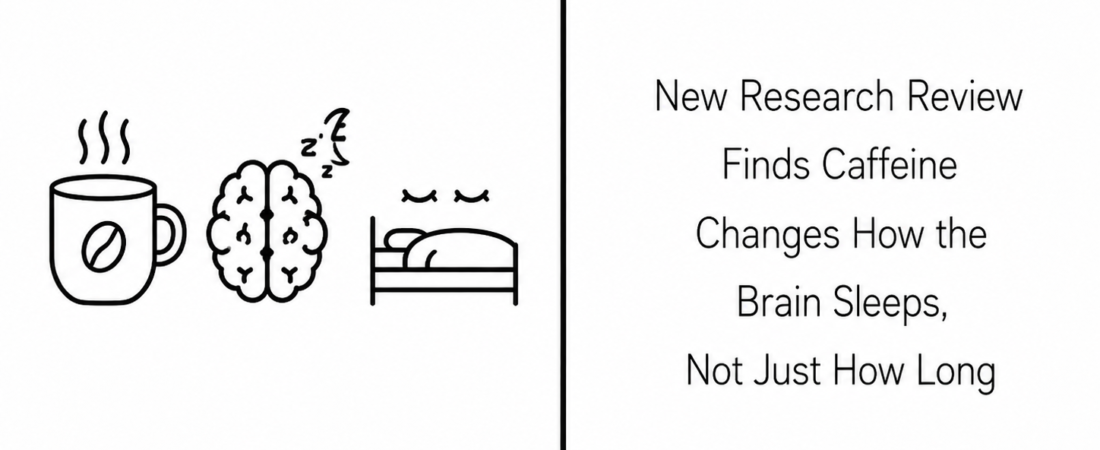
The most discussed caffeine science story of the day reframes an old question. According to Daily Coffee News on August 31, a systematic review published in the journal Nutrients concludes that caffeine can change the brain’s electrical activity during sleep even when sleep duration remains largely the same, suggesting that whether coffee makes it harder to fall asleep may be the wrong measure of its nighttime cost. The review, authored by James Chmiel of the University of Szczecin and Donata Kurpas of Wroclaw Medical University in Poland, analyzed 32 human studies that combined caffeine exposure with sleep EEG, the method for recording the brain’s electrical activity, and its central finding is that caffeine may make sleep less restorative even when sleepers perceive no disruption at all.
EEG Reveals Disruption That Sleep Duration Measures Miss
The review’s methodological point explains its impact. Classical sleep assessment tracks duration, stages, and awakenings, but quantitative EEG analysis captures the biological quality of sleep itself. According to the review’s findings, caffeine consumption suppressed high-amplitude slow-wave activity, the deep-sleep signature associated with physical restoration and memory consolidation, while increasing faster brain activity in the spindle and beta ranges. The authors described the combined result as a lighter, more aroused and more wake-like sleep EEG profile. In other words, a person under caffeine’s influence can sleep the same number of hours while the brain spends measurably less of that time in its most restorative modes.
Feeling Rested Does Not Guarantee Restorative Sleep
The review’s most counterintuitive finding concerns self-perception. According to Daily Coffee News, participants’ subjective reports of sleep quality repeatedly failed to track the EEG evidence of disruption across the analyzed studies. Kurpas noted that the subjective feeling of having slept well does not always correspond to what appears in neurophysiological recordings, explaining that a person may fall asleep without difficulty and remember no awakenings while the brain displays fewer features of deep sleep. The mismatch matters practically: consumers who judge their caffeine timing by whether they feel they slept fine may be systematically underestimating the cost, particularly the drinkers who insist an after-dinner espresso never affects them.
Recovery Sleep and Younger Brains Show the Strongest Effects
The review adds detail about when and for whom the effects intensify. According to the report, caffeine’s EEG alterations were especially pronounced in recovery sleep following sleep deprivation, a direct caution for the common practice of using caffeine to push through fatigue and then counting on the next night to repair the deficit. The findings align with a University of Montreal study that found 200 mg of caffeine kept sleeping brains in a more active, complex state resembling a critical wake-like regime, with the strongest effects during non-REM sleep and in adults aged 20 to 27, whose higher density of adenosine receptors makes them more responsive to the compound the stimulant blocks.
The Practical Message Is Dose and Timing, Not Abstinence
The researchers frame the findings as an argument for individual awareness rather than alarm. According to the review’s authors, responses to caffeine vary enormously with genetics, metabolic rate, age, stress, and habitual intake, meaning the same afternoon serving can be trivial for one sleeper and consequential for another. The consistent implication across this research is that caffeine’s sleep cost is governed by how much remains active at bedtime, which returns to familiar arithmetic: moderate doses, consumed earlier, with exact milligram content known, minimize the residual caffeine that reshapes the sleeping brain. The science, once again, rewards the consumer who can count precisely what they consumed and when.
Jiggle’s caffeine gummies make that counting effortless, delivering a precise 63 mg of plant-based caffeine per gummy from green tea extract and guarana, with no artificial ingredients. Each resealable pack of 12 gummies carries a 24-plus-month shelf life and retails for $18.99. Learn more at jiggle.cafe.
As EEG research keeps revealing what duration-based sleep tracking cannot see, the caffeine conversation is shifting from whether consumers fall asleep to how well their brains sleep, and measured, well-timed doses remain the science’s clearest recommendation.