
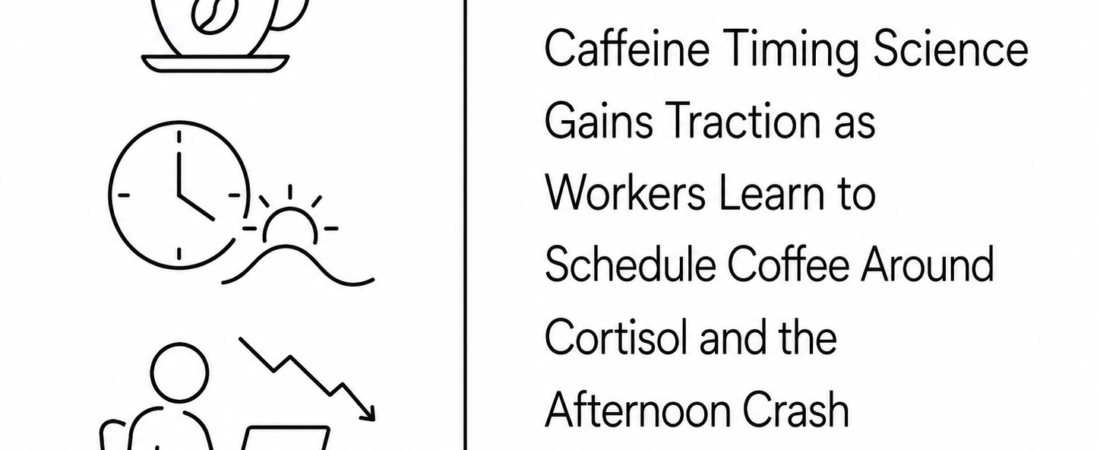
The productivity world’s caffeine focus this week is the clock rather than the cup. New guidance circulating August 13, including a widely shared explainer on the science of caffeine timing and how to drink coffee without the afternoon crash, reflects growing mainstream interest in scheduling caffeine around the body’s natural rhythms instead of consuming it reflexively. The approach draws on chronobiology research into cortisol, adenosine, and caffeine’s half-life, and it lands with an audience already primed by this summer’s viral sleep frameworks. The emerging consensus among sleep and performance researchers is that when caffeine is consumed matters nearly as much as how much, and that most workers time it poorly.
The Cortisol Awakening Response Argues Against the Immediate Morning Cup
The first timing insight concerns the start of the day. According to chronobiology research, cortisol, the alerting hormone, surges naturally in the first 30 to 60 minutes after waking in a pattern known as the cortisol awakening response, meaning the body is already running its own stimulant program when many people reach for their first cup. Sleep researchers who popularized the timing framework suggest delaying the first caffeine serving roughly 60 to 90 minutes after waking, allowing the cortisol peak to pass so caffeine’s adenosine-blocking effect arrives when natural alertness begins declining. Proponents argue the delay produces a smoother alertness curve and reduces the late-morning dip that immediate consumption can create.
The Afternoon Crash Is an Adenosine Story, Not an Energy Story
The framework’s central explanation concerns what caffeine actually does. According to sleep science, caffeine does not create energy but blocks adenosine, the neurochemical that accumulates during waking hours and signals mounting sleep pressure; the adenosine keeps building behind the blockade, and when caffeine clears, the accumulated signal arrives at once, producing the familiar afternoon crash. Timing strategists draw two lessons: consuming caffeine before the crash arrives, rather than after, prevents the trough instead of chasing it, and stacking repeated large doses late in the day merely postpones an increasingly severe payback while pushing active caffeine into the sleep window, where it degrades the recovery that tomorrow’s alertness requires.
Half-Life Math Sets the Afternoon Cutoff
The third pillar is elimination speed. According to the American Academy of Sleep Medicine, caffeine’s half-life runs roughly three to five hours, extending longer in slow metabolizers, which means a mid-afternoon serving leaves a meaningful fraction of its dose active at bedtime. Sleep specialists cited throughout this summer’s coverage, including the widely circulated 10-hour pre-sleep cutoff frameworks, converge on ending caffeine intake by early-to-mid afternoon for typical sleep schedules. Research on sleep architecture adds the crucial detail that residual caffeine harms sleep quality even when it does not prevent sleep onset, reducing slow-wave and REM stages that govern memory consolidation, recovery, and next-day cognitive performance.
Scheduled Moderate Doses Outperform Reactive Large Ones
The practical synthesis now circulating in productivity coverage is a schedule. According to performance researchers, the optimized pattern looks like this: a first moderate dose 60 to 90 minutes after waking, an optional second moderate dose before the early afternoon, timed ahead of the anticipated dip, and a firm cutoff that keeps the final dose eight to ten hours from bedtime. Moderate, repeated doses sustain attention with less variance than single large ones, and knowing each dose’s exact milligram content is what makes the arithmetic workable. The framework’s popularity reflects a broader shift in work culture, treating caffeine as a scheduled performance tool with a dose and a clock rather than an unlimited ambient habit.
Jiggle’s caffeine gummies are built for that scheduled approach, delivering a precise 63 mg of plant-based caffeine per gummy from green tea extract and guarana, easy to time and easy to count. The resealable pack of 12 gummies retails for $18.99. Learn more at jiggle.cafe.
As caffeine timing joins sleep hygiene in the mainstream productivity toolkit, the workday cup is becoming an appointment rather than a reflex, and the products that fit neatly into a schedule are the ones positioned to benefit.